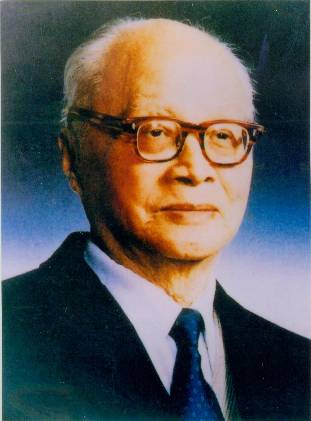
Wang Ganchang was a nuclear physicist. He was a native of Changshu, Jiangsu Province. Wang was a member of both the Jiu San Society and the Communist Party of China. He graduated from the Department of Physics of Tsinghua University in 1929. In 1933, he received a doctoral degree from the University of Berlin in Germany. He returned to China in 1934 and successively served as a professor and director of the Department of Physics of Shandong University and Zhejiang University, director of the Institute of Modern Physics of the Chinese Academy of Sciences, vice president of the Ninth Institute of the Second Ministry of Machinery Industry (now China National Nuclear Industry Corporation). Later, he became the vice minister. Concurrently, Wang worked as director of the Institute of Atomic Energy of the Ministry (now China Institute of Atomic Energy), director of the Specialty Group of Nuclear Fusion of the China Association for Science and Technology, director of the Committee of Cold Testing Technology, vice chairman of the Chinese Association of Science and Technology, chairman of the Chinese Nuclear Society, and chairman of the Central Consultative Committee of the Jiu San Society. Wang was a member of the Standing Committee of the 3rd to 6th National People’s Congress. He was a founder and leader of experimental nuclear physics and physical studies on cosmic rays and elementary particles in our country. In 1941, he innovatively put forward the experimental method of using light atomic nuclei to capture the recoil neutrinos which are generated when K shell electrons release neutrinos, which could be used to verify the existence of neutrinos. This assumption was confirmed by experiments. In 1959, Wang led the research team at the Dubna National Joint Institute for Nuclear Research in the former Soviet Union to discover the anti-sigma negative hyperon for the first time in the world. This discovery greatly improved people’s understanding of the world of microscopic matter. In 1964, he independently raised the idea of achieving nuclear fusion via laser shooting. Wang was one of the founders of the theory and research of laser-initiated inertial-confinement fusion in the world, which also made China’s scientific research in this field ranked top internationally at that time. In 1984, he initially opened the new research field of laser-initiated inertial-confinement fusion of krypton excimers. Wang also participated in the research and direction of theoretical breakthrough in studies of atomic bombs and hydrogen bombs and experiments of nuclear weapons development. He made outstanding contributions to the country’s cause of science and technology and national defense construction. In 1986, together with Yang Jiachi and Chen Fangyun, Wang made a proposal for the development of high technology in China. With Deng Xiaoping’s instructions and vigorous support, the State Council listened to experts’ opinions and formulated the “Guideline on National High-Tech Research and Development,” namely the “863 Programme,” which turned a new page in China’s high-tech development. He won quite a number of important awards, including two first prizes of the National Natural Science Award and one special prize of the State Science and Technology Progress Award. In 1999, Wang was posthumously awarded the “Two Bombs and One Satellite Medal.” He was the author of such books as Neutrinos and Negative Protons, and Selected Papers of Wang Ganchang, etc. In 1955, Wang was elected as an academician of the Chinese Academy of Sciences. (Member of the CAS)





