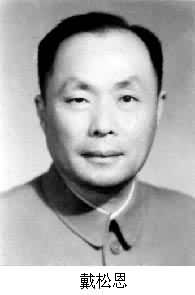
Dai Songen was an expert in genetic breeding. He was a native of Changshu, Jiangsu Province. Dai was a member of the China Democratic League and a member of the Communist Party of China as well. He graduated from the Department of Agronomy of the College of Agriculture of Nanjing Jinling University (formerly Nanjing Institute of Agriculture, the predecessor of today’s Nanjing Agricultural University) in 1931. In 1936, he received his doctorate degree from Cornell University. Zhou once served as the director of the Wheat Department of the Central Research Institute of Agriculture, the director of the Beiping Agricultural Experiment Farm, and the director of the Hubei Provincial Institute of Agricultural Improvement, etc. He later worked successively as a research fellow and deputy director of the North China Institute of Agricultural Sciences; the deputy secretary general, the deputy director of the postgraduate school, and a research fellow and deputy director of the Institute of Crop Breeding and Cultivation of the Chinese Academy of Agricultural Sciences. He was once elected as the deputy director and secretary general of the Crop Science Society of China. Dai was also a delegate to the 3rd National People’s Congress, a member of the Central Committee of the 4th and 5th of the China Democratic League, and a member of the 5th and 6th CPPCC National Committee. He participated in the breeding of the first batch of high-quality wheat varieties in China, including “Jinda No. 2905” and “Jinda No. 26,” etc. Through close studies, he specified the inheritance laws and genetic linkage of over 10 properties in the hybrid offsprings of six wheat varieties from China, Russia and the United States. Dai pointed out for the first time that under strict inoculation conditions, the wheat varieties from China exhibited obvious differences in their resistance to Fusarium Head Blight, and thus confirmed the possibility of breeding wheat varieties that bore strong resistance to FHB. He also pointed out that the direct use of American maize double hybrid cannot increase yield. Only by reasonably combining and matching its inbred lines with Chinese materials can high-yield hybrid maize suitable for China be obtained. Dai successfully selected and bred excellent tobacco varieties suitable for the areas around Guiyang, and explored the ways and methods of breeding oilseed rapes suitable for our country. Since 1978, he directed and carried out the research on aneuploid of Chinese wheat varieties, and argued that ph-gene could be used to induce genetic variations in intervarietal hybridization. He won the Commendation Award issued by the Chinese Academy of Agricultural Sciences in 1983 for his devotion to research work in the field of agriculture, and the honorary award issued by the Chinese Academy of Sciences in 1985 for his engagement in scientific research for five decades. Dai was the author of The Science of Seeds. In 1955, he was elected as an academician of the Chinese Academy of Science (Member of the CAS).





