


As chronicled in Records of Wu (Wu Di Ji), the capital city built by King Helv of Wu was designed to be surrounded by “eight land gates, aligning the Eight Winds of Heaven; and eight water gates, corresponding to the Eight Trigrams of Earth.” The eight land gates are Changmen Gate and Xumen Gate in the west, Panmen Gate and Shemen Gate in the south, Loumen Gate and Jiangmen Gate in the east, and Pingmen Gate and Qimen Gate in the north. Names for the eight gates varied across historical records. According to A Sequel to the Illustrated Treatise of Wu Prefecture, there was no Pingmen Gate. But Fengmen Gate did exist. Pingmen Gate actually bore the alternative name Wumen Gate, yet both Pingmen Gate and Chimen Gate were not included in the above mentioned eight gates. During the Wu period, the gates on the east side of the city were locked, as a measure to prevent invasions conducted by the State of Yue. All the eight gates were open during the Tang Dynasty. In the early Northern Song Dynasty, Shemen Gate and Jiangmen Gate were filled and closed, leaving the six gates of Changmen Gate, Xumen Gate, Panmen Gate, Fengmen Gate, Loumen Gate, and Qimen Gate open for public use. In the Southern Song Dynasty, for the sake of defense, only five of the gates remained open. When the rebel leader Zhang Shicheng took Suzhou in the late Yuan Dynasty, he added Yuecheng (meaning “barbicans”) to the six gates. These barbicans were later dismantled after the Taiping Heavenly Army captured the city. These fortifications at the five gates, namely Fengmen Gate, Loumen Gate, Qimen Gate, Xumen Gate, and Changmen Gate, were restored when the Qing government recaptured the city.
During the Republican era, Jinmen Gate, Pingmen Gate, Xiangmen Gate, and Xinxumen Gate were successively opened or reopened. By the time of the city’s liberation in 1949, Suzhou had had ten city gates, namely Changmen Gate, Xumen Gate, Panmen Gate, Fengmen Gate, Xiangmen Gate, Loumen Gate, Qimen Gate, Pingmen Gate, Jinmen Gate, and Xinxumen Gate. Since the establishment of the People’s Republic of China, most of these gates were successively pulled down. The three remaining ones were Panmen Gate, Xumen Gate, and Jinmen Gate. In recent years, Suzhou has placed great emphasis on the protection and restoration of ancient city walls. With several conservation projects, six city gates—Changmen Gate, Xiangmen Gate, Pingmen Gate, Loumen Gate, Qimen Gate, and Fengmen Gate—along with parts of their wall sections have been restored. Suzhou City Wall Museum was opened to the public in 2013.
Loumen Gate
Loumen Gate is located in the northeast of Suzhou. According to Records of Wu, “Loumen Gate was initially called Liumen Gate (疁门). Dating back to the Qin Dynasty, to the southeast of the Gate lay the ancient Liuxian County, which was renamed Louxian County under Wang Mang in the Han Dynasty.” Consequently, the gate was renamed Loumen Gate. After the gate tower was rebuilt in the early Qing Dynasty, a plaque was put up, which bore the phrase “Jiang Hai Yang Hua,” meaning “The Loujiang River, as mighty as the sea, carries the affluence and prosperity of Suzhou to distant lands.”
The gate complex consisted of three successive gates: the outer, middle, and inner ones. The innermost gate housed a fortified gate tower. The spaces between the three city gates were equipped with open grounds and portcullises, making the structure exceptionally robust. The three water gates were also fitted with portcullises. The gate towers on the outer, middle, and inner-city gates were dismantled around 1948 during the Republican era. In 1958, the inner gate and water gates were torn down as well.
The Suzhou municipal government undertook the second phase of its city wall preservation programme in 2013, which took six months to restore Loumen Gate tower and parts of the adjoining city wall. The new Loumen Gate impressed local people with its brand-new look.
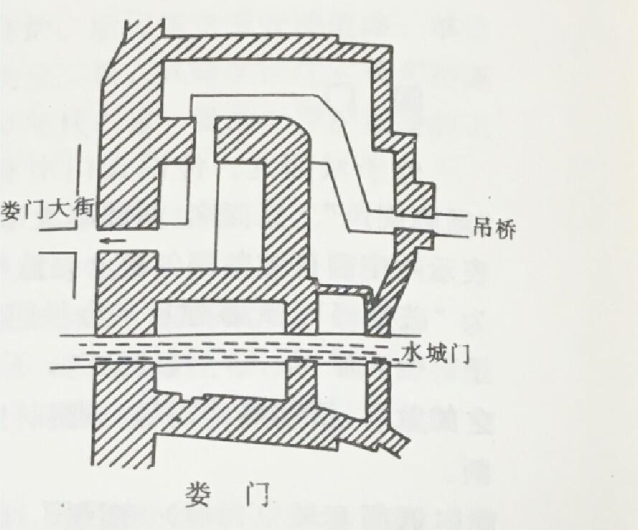
▲ Diagram of Loumen Gate
A Selection of Poems on Loumen Gate
One of the Miscellaneous Poems of the Year Jihai
Gong Zizhen
Delayed by the wind, without any wine, my heart sinks even more;
How much more so in the late autumn, with willows stand bare by the shore.
Fortunately, I can find solace in a warm and heartfelt talk with my nephew;
As so, in a chilly drizzle, my lone sail passes through Loumen Gate.
Visiting Gardens with My Elder Brother Zhixian to Admire the Peonies
Fan Chengda
Leaning on my cane, I roam freely through the boundless spring;
Amidst pink and red blossoms, I can do nothing but succumb to spring’s charm.
Yesterday at Changmen Gate, the views weren’t enough for me;
Today at Loumen Gate, I find an even grander display of blooms.
Bees and butterflies bustle through wild grass gleaming with dew,
A tiny cottage enclosed with fences stands in desolate late-spring chill.
If you are eager to understand the phrase “peerless beauty and celestial fragrance;”
You must lean on the rails and gaze at the flowers by the light of a burning candle.
The Northern Study
Ye Shi
For years I dwell in Wu County,
My official lodge is mixed in with army posts;
The front hall has caved in under its weight;
The back rooms stay lean and tilt.
Quite often, after extended rains,
The walls are stained and beyond cleansing.
Leaping frogs bathe in the water a broken jar holds,
While wild grains charmingly grown toward the sunlight cast in through cracks.
Thus I’ve failed in my duty to be a cheerful son to care for my aged parents;
The thought of going home and facing them fills me with shame.
I bow my head, idly humming a mournful old tune;
Then, gazing into the distance, I feel my heart grow lighter and my sorrows fade.
In one’s lifetime, it’s truly easy to feel contented,
But hoarding wealth for posterity is not the wise or lasting way.
Fortunately, the repairs are done,
The pillars and rafters stand sound and straight.
Through sunlit windows, the long daylight stretches into the house;
Lying on the couch, I can feel the cool of the night arrives early.
Friends sit together in harmony and ease,
While small birds chirp lively in the grass.
A noble man’s home follows his character;
A wicker gate is strengthened and viewed as a treasure.
What’s more, as a native of this water town,
He is familiar with fallen beams ruined by mire and flood.
I wrongly turned from the duties of an envoy;
My true duty is to revive withered souls.
What men admire and long for,
May not necessarily be what Heaven can grant.
I roll and put away my scrolls, then retire;
Those worm-eaten books speak strength and truth.
A Selection of Old Photos of Loumen Gate
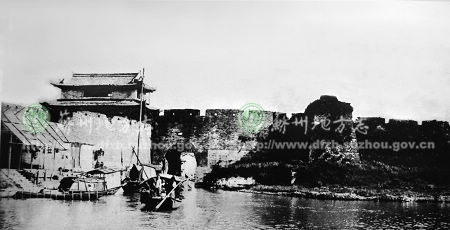
▲ Loumen Gate and the City Moat (taken in the early Republican era)
Loumen Gate is situated in the northeast of the city. After the reconstruction of its gate tower in the early Qing Dynasty, a plaque was put up on it inscribed with the characters “Jiang Hai Yang Hua” (meaning “The Loujiang River, as mighty as the sea, carries the affluence and prosperity of Suzhou to distant lands.”). The gate tower was dismantled about 1948. In 1958, the inner gate and water gates were demolished as well.
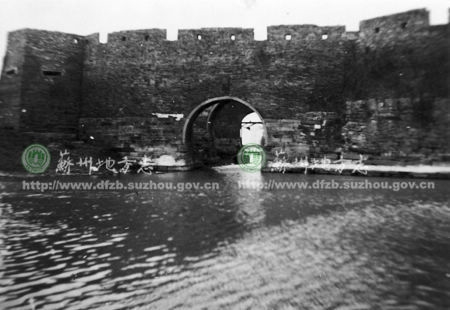
▲The Water Gate Complex of Loumen Gate (1932)
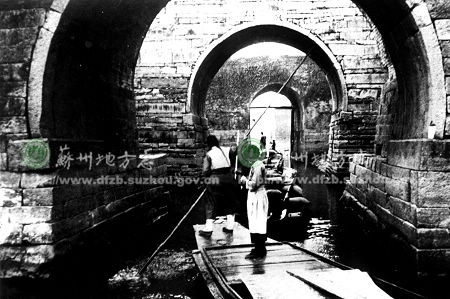
▲The Water Gate Complex of Loumen Gate (1932)
This water gate complex featured an enclosed defensive courtyard consisting of inner and outer barbicans. It had three consecutive gates armed with sluice structures. This unique design is the only one of its kind in Suzhou. The gate was demolished in 1958.
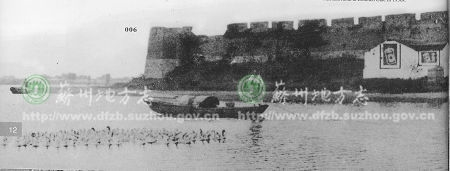
▲The Northeastern Corner of the City Wall at Loumen Gate and the Moat (taken in the 1930s)
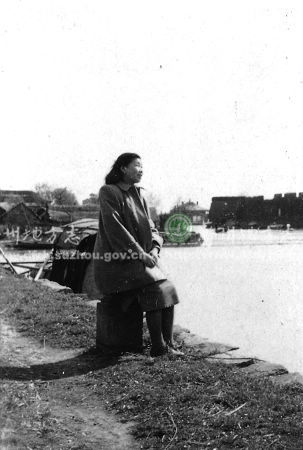
▲ By the Moat at Loumen Gate
In the past, the area outside Loumen Gate was just sparsely dotted with people’s homes. Along the riverside fishing boats were moored. The scene captured in the photo was imbued with rustic charm. Ladies living in the city took an excursion here to enjoy the delights of the countryside.
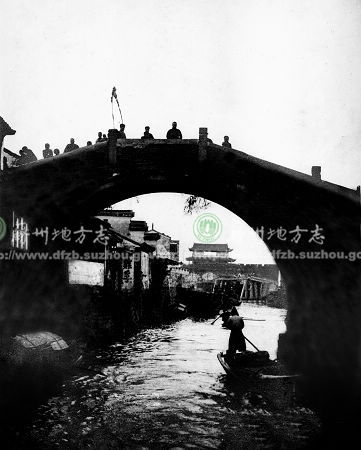
▲ Loumen Gate and the Yongning Bridge
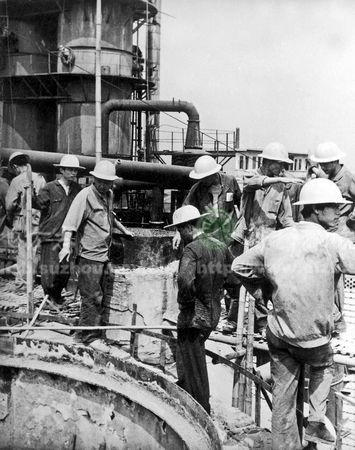
▲ Suzhou Sulfuric Acid Plant (1975)
In 1958, Suzhou Sulfuric Acid Plant broke ground by the Su-Kun Highway outside Loumen Gate. It was completed and commenced operations on October 5, 1959. The plant was then the first of its kind in Jiangsu Province to be a sizeable enterprise with increasingly mechanized operation and integrated production. The photo, taken in 1975, shows technical personnel working on the production line to resolve technical challenges.
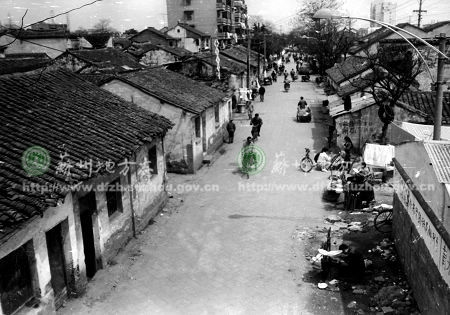
▲ Loumenwai Street (taken in the 1980s)
Loumenwai Street extended westward to Dongbeijie Street and eastward to Suzhou Sulfuric Acid Plant. It was demolished during the reconstruction of Loumen Road in 2000. The photo shows the streetscape east of the Xiangyang Bridge.
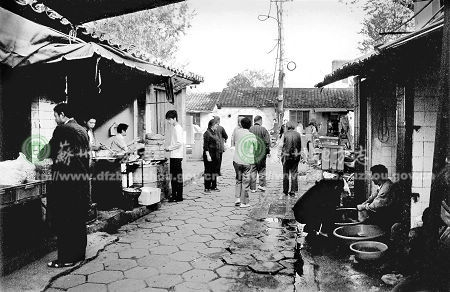
▲ Loumenheng Street (taken in the 1980s)
Loumenheng Street extended south to Cangjie Street and north to Qiaowan Street. This photo captures a scene of the market inside Loumen Gate.
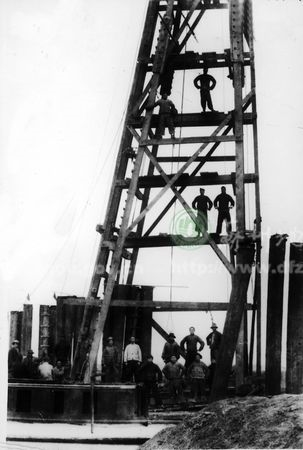
▲ Bridge Builders (1935)
With the construction of highways and railways, Suzhou began to build major bridges. This photo captures a scene when the Loumen Bridge was being constructed as part of the Su-Jia (Suzhou-Jiaxing) Railway project.
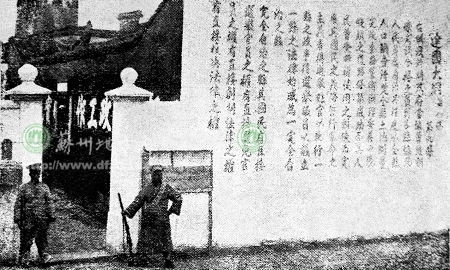
▲ District Government Office of the First District, Wuxian County (1930)
The district government office of the First District of Wuxian County was located on Loumenwai Street.
A Selection of Photos of Present-Day Loumen Gate
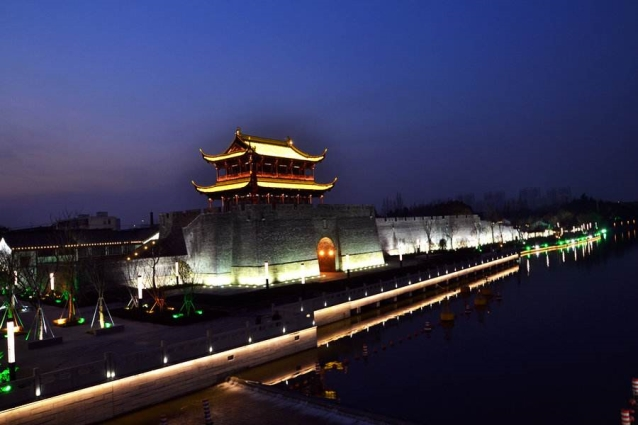
▲ Loumen Gate by Night
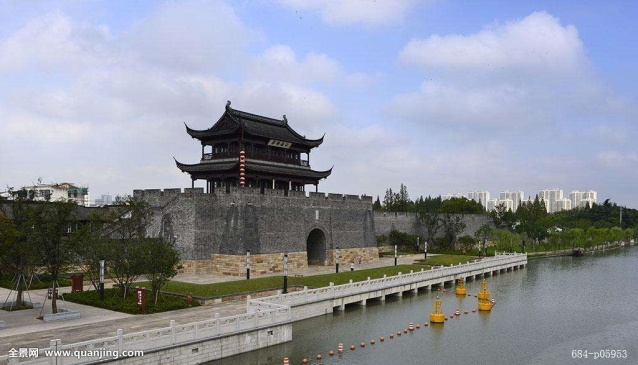
▲The New Loumen Gate
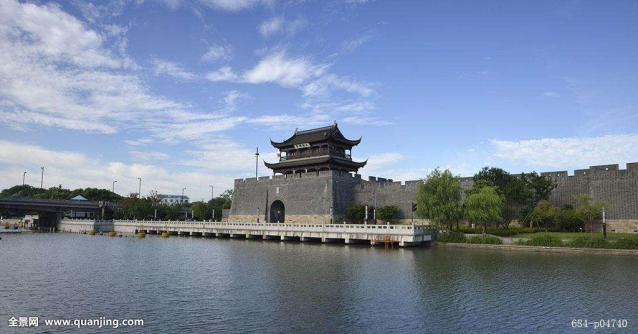
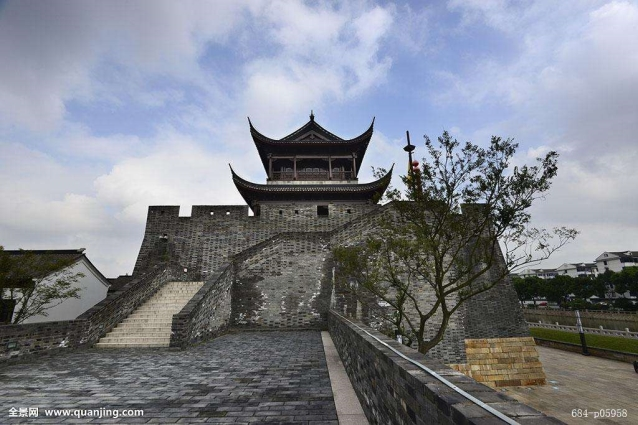
▲A View of Loumen Gate
An Introduction to the Humble Administrator’s Garden
The Humble Administrator’s Garden nestled in the northeast corner of the old city area of Suzhou, at No. 178 Northeast Street inside Loumen Gate. The garden, known as the foremost of China’s “Four Great Gardens,” is an outstanding representative of classical gardens in the area south of the Yangtze River. It is listed as a major historical and cultural site and a UNESCO World Heritage Site. The garden covers an area of nearly 80 mu.
Originally built during the Ming Dynasty, the garden was expanded by Wang Xiancheng in the fourth year of Emperor Zhengde’s reign. He named it “Humble Administrator’s Garden,” drawing inspiration from a line in Pan Yue’s “On Dwelling in Idleness:” “I water my garden and sell vegetables to provide myself with daily meals... This is indeed how a clumsy man like me manages his affairs.” Wen Zhengming, one of the “Four Masters of Ming,” once created thirty-one paintings depicting the varied garden views. In the Qing Dynasty, the scholar Yu Yue praised the garden by “Among all the gardens in Suzhou, none surpasses the Humble Administrator’s Garden” and “The renowned Humble Administrator’s Garden crowns the Wu County.”
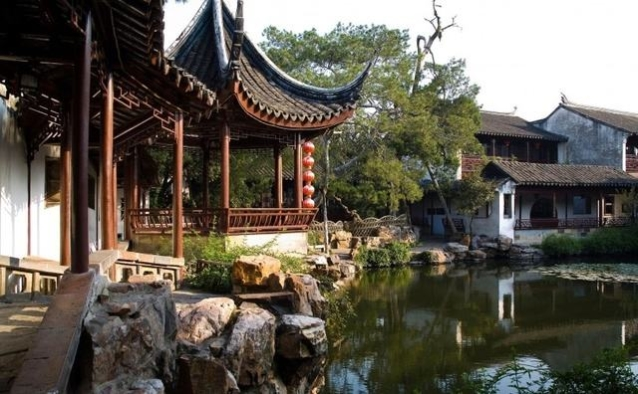
The Humble Administrator’s Garden in Spring
