As chronicled in Records of Wu (Wu Di Ji), the capital city built by King Helv of Wu was designed to be surrounded by “eight land gates, aligning the Eight Winds of Heaven; and eight water gates, corresponding to the Eight Trigrams of Earth.” The eight land gates are Changmen Gate and Xumen Gate in the west, Panmen Gate and Shemen Gate in the south, Loumen Gate and Jiangmen Gate in the east, and Pingmen Gate and Qimen Gate in the north. Names for the eight gates varied across historical records. According to A Sequel to the Illustrated Treatise of Wu Prefecture, there was no Pingmen Gate. But Fengmen Gate did exist. Pingmen Gate actually bore the alternative name Wumen Gate, yet both Pingmen Gate and Chimen Gate were not included in the above mentioned eight gates. During the Wu period, the gates on the east side of the city were locked, as a measure to prevent invasions conducted by the State of Yue. All the eight gates were open during the Tang Dynasty. In the early Northern Song Dynasty, Shemen Gate and Jiangmen Gate were filled and closed, leaving the six gates of Changmen Gate, Xumen Gate, Panmen Gate, Fengmen Gate, Loumen Gate, and Qimen Gate open for public use. In the Southern Song Dynasty, for the sake of defense, only five of the gates remained open. When the rebel leader Zhang Shicheng took Suzhou in the late Yuan Dynasty, he added Yuecheng (meaning “barbicans”) to the six gates. These barbicans were later dismantled after the Taiping Heavenly Army captured the city. These fortifications at the five gates, namely Fengmen Gate, Loumen Gate, Qimen Gate, Xumen Gate, and Changmen Gate, were restored when the Qing government recaptured the city.
During the Republican era, Jinmen Gate, Pingmen Gate, Xiangmen Gate, and Xinxumen Gate were successively opened or reopened. By the time of the city’s liberation in 1949, Suzhou had had ten city gates, namely Changmen Gate, Xumen Gate, Panmen Gate, Fengmen Gate, Xiangmen Gate, Loumen Gate, Qimen Gate, Pingmen Gate, Jinmen Gate, and Xinxumen Gate. Since the establishment of the People’s Republic of China, most of these gates were successively pulled down. The three remaining ones were Panmen Gate, Xumen Gate, and Jinmen Gate. In recent years, Suzhou has placed great emphasis on the protection and restoration of ancient city walls. With several conservation projects, six city gates—Changmen Gate, Xiangmen Gate, Pingmen Gate, Loumen Gate, Qimen Gate, and Fengmen Gate—along with parts of their wall sections have been restored. Suzhou City Wall Museum was opened to the public in 2013.
Xumen Gate
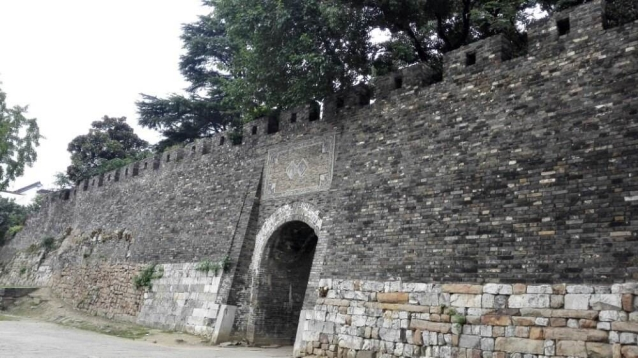
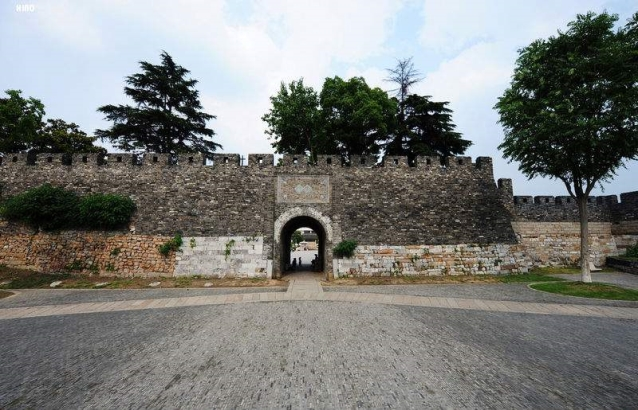
Xumen Gate, also known as the Old Xumen Gate, stands south of Wannian Bridge in the west of Suzhou. It is one of the ancient gates constructed when the State of Wu had its capital built during the Spring and Autumn Period. There are three prevailing accounts regarding the gate name. One account suggests it was named for its location where one could see the distant Guxu Mountain (also known as Gusu Mountain). Another holds that during the Spring and Autumn period, the renowned statesman Wu Zixu assessed the terrain and waters, and modeled Suzhou’s layout after heaven and earth to build the city. Though over 2,500 years has passed, the city area still retains the design of “a fortress with inner and outer walls,” advocated by Wu Zixu. The gate was named in his honor by later generations. Still another account states that King Fuchai of Wu put his trust in treacherous officials and ignored Wu Zixu's counsel. The king even forced Wu to commit suicide. After his death, Wu’s head was displayed high on the city gate. The gate was hence named. In 1982, Xumen Gate was designated as a Municipal cultural relic protection unit. The surviving structure dates back to its reconstruction in the 11th year of the Zhizheng era during the Yuan Dynasty (1351) which underwent subsequent renovations during the Ming and Qing Dynasties.
A Selection of Poems on Xumen Gate
Written in Response to “A Leisurely Boat Ride by Xumen Gate”
Lu Guimeng
(Tang Dynasty)
My slender oar dips gently to part water clovers,
By the ancient city wall, blooms give way to fresh green shades.
In this age, are there still people who flee from fame?
I ask the one in sandals by the South Pond.
The Song of Han Xizi
Jiaoran
(Tang Dynasty)
You stand on Lushan Mountain, far apart from the crowd;
Others wonder whether you are a crane or a cloud.
Untouched by the dust of life and death,
You see fame and gain swarm by.
Today, you graciously came to my place,
With a wine jar and one book-bag on your shoulders.
You brush from your robe the hues of cloud and mist;
After lodging at the Cai’s by Xumen Gate last night.
By nature, you don’t care much for drinks and food;
You’ve dropped your name, and none can find you.
Yet you choose to be a wine lover when in the mortal world,
Rather than a winged immortal in heaven.
Master Qizi preserves his physical form by drawing from essence of Heaven and Earth;
While all men meet their end, he alone endures.
He cleanses his soul by swallowing the pure wisdom;
While all men crave for more, he feels contented.
He has now mastered the Way;
His hand holds the cosmic pivot; his mind sets in deep meditation.
He could command spirits to weep and ghosts to serve at his will;
His form, like a light wind, can never be kept by any chains.
At dawn, he roams Mount Kongtong; by dusk the far end of the world;
Yet the guests where he sat in the morning have not left,
Then he thinks of the sacred Luofu Mountain he’s longed to visit,
And points to a lone cloud below as his guide.
But the fairy seas are beyond our mortal gaze;
As the sun sets on our world, the mulberry branches stretch bare.
Song of Dongxian (Song of the Grotto Immortal)
Huang Zai
(Song Dynasty)
The old palace of the Wu State resembles a painting by Heaven’s hand.
Through layers of clouds, its soaring terrace shows.
Dim towers hang among emerald peaks.
Winding streams embrace Wucheng (today’s Yangzhou),
While fields stretch far and vast.
Woods, touched by frost, have lost all their glory.
On the Yuelai Stream, wild geese cry with urgent breath;
Their mournful cries disorderly ebb and flow,
As if they were searching near the ancient Xumen Gate and resenting the king of Wu who broke his faith.
The bestowed sword Zhuanlu sank into the river with its master,
While the severed Xiangxi Stream marked Xi Shi’s fate.
Dreams dispersed just like vanished clouds.
A thousand years have passed;
All have become the stuff of talk for woodcutters and fishermen.
When gazing far, I could only see the ancient terrace veiled in misty green,
While amidst withered grass, the setting sun descends in the west.
Departing Suzhou at Dawn, I Meet an Old Friend
Wei Geng
(Qing Dynasty)
When the moon descends as the golden Changmen Gate, a rooster crows;
A crane perches on the city wall alone where cold frosts grow.
My lean horse whinnies slowly, and my gown is short and worn;
The long road winds ahead through passes one after another.
I meet men of the world, who are all displaced and in distress;
I weep face to face with those in southern caps (a sign for prisoners), for half are my fellow townsmen.
I turn around and realize regrets against the State of Wu remain alive;
Old as it is, Xumen Gate still gazes at the flowing rivers.
A Selection of Old Photos of Xumen Gate
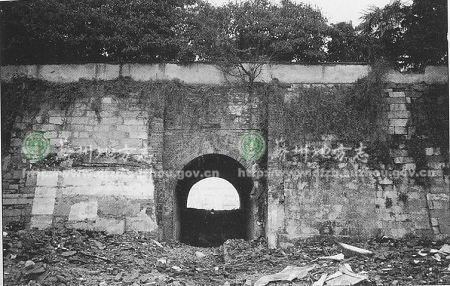
▲ Doorway of Xumen Gate
Xumen Gate is situated in the west of Suzhou. It is also known as Guxu Gate, named after the nearby Guxu Mountain. Legend has it that Wu Zixu’s residence was close by. Later, after his execution, Wu’s head was displayed upon this very gate, and the gate was thus named Xumen Gate. During the Warring States period, the State of Chu conquered the State of Wu and Lord Chunshen started his governance here. Since then, there was no water gate in the gate complex. A plaque inscribed with the characters “Gu Xu Yong Cui” (meaning “Guxu Gate embraced by lush foliage”) was installed when the gate tower was rebuilt in the early Qing Dynasty. This photo was taken during the Republican era.
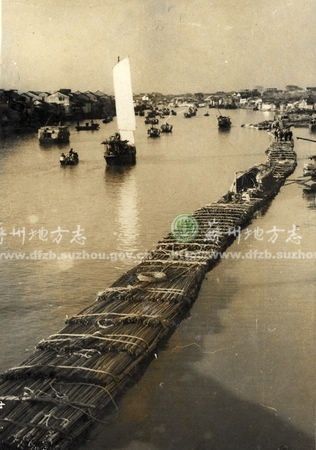
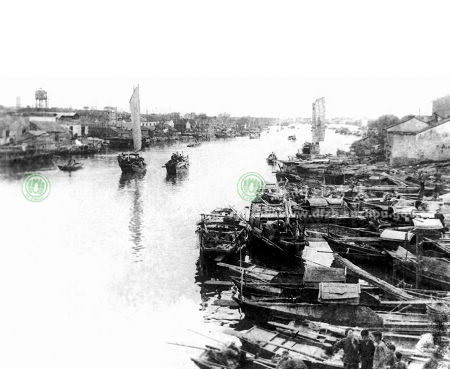
▲ The Canal by Xumen Gate
The Canal flowing by Xumen Gate, commonly known as the Xujiang River, winds in the southwest of Suzhou. It stretches from the outer moat at Xumen Gate to Xukou, a town five kilometers west of Mudu Town. The river is traditionally believed to have been excavated by Wu Zixu and served as the primary floodway on the southeastern shore of Taihu Lake. The above pictures show chronologically:
1. The moat south of the Wannian Bridge in the 1940s.
2. The Xujiang River soon after the Liberation.
3. The Canal by Xumen Gate in the 1960s.
4. The confluence of the Xujiang River and the moat in the 1970s.
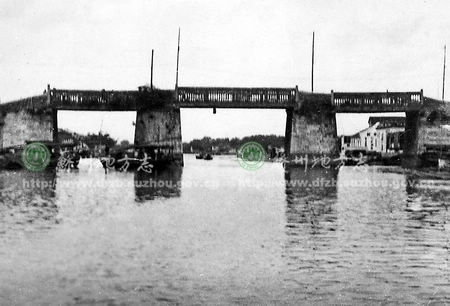
▲ The Wannian Bridge at Xumen Gate
The Wannian Bridge was first built in the 5th year of Emperor Qianlong’s reign (1740). Its foundations and the two piers set in the river were laid with square granite blocks, upon which massive beams of fir timber were arranged, forming a structure characterized by a flat deck and square openings. The bridge was approached by 53 stone steps on each slope, which were topped with wooden railings. In 1936, those stone steps were replaced by sloped ramps. The year 1952 saw the original framework replaced by concrete girders. The bridge connects to Xumen Road at both ends. In 2003, it was reconstructed during the project of preserving the historic scenery around the old city area. The two photos above show the Wannian Bridge as it appeared in 1932 and in the 1980s.
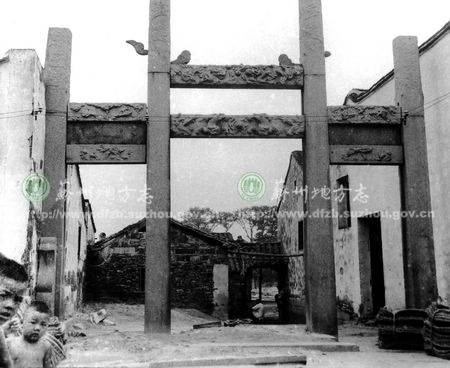
▲The Memorial Archway on Wannianqiao Street
The Memorial Archway on Wannianqiao Street at Xumen Gate, also known as the Archway of “An Unforgettable Benefactor”, was situated at the Reception Pavilion for Officials. It was erected in memory of Tang Bin, the Governor of Jiangsu Province during Emperor Kangxi’s reign of the Qing Dynasty.
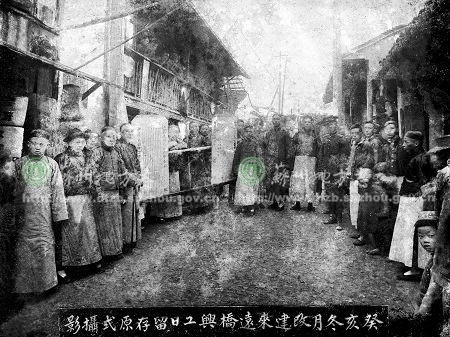
▲ The Laiyuan Bridge at Xumen Gate
Rumor has it that during the Southern Song Dynasty, there was a Gusu Hostel near Xumen Gate, serving as a reception station for envoys from northern kingdoms and traveling officials. The bridge was in front of this hostel whose name “Lai Yuan” was taken from the line in The Analects: “Is it not a joy to have friends coming from afar?”
The first photo provided is a commemorative one taken on the commencement day of the reconstruction of the Laiyuan Bridge in 1923 by the Xupan Civic Association. The other is the Laiyuan Bridge as it appeared in the 1980s.
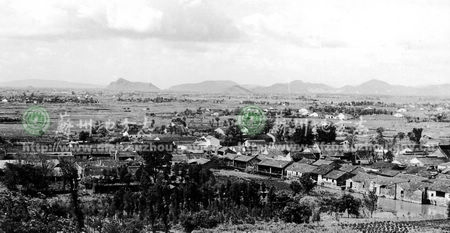
▲ A Bird’s-eye View from within Xumen Gate
This photo offers a panoramic view of residential homes along Nianzhu Street, Jiqing Street, and Xidajie Street. The multi-story building on the left is the former Xinsu Normal School, while the Ruiguang Pagoda stands in the background. This network of streets and alleys was completely demolished and redeveloped in 1997. The picture was taken in the 1980s.
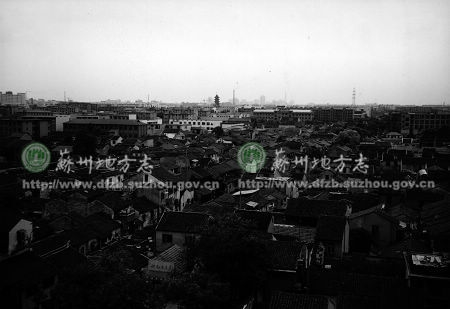
▲ The Countryside beyond Xumen Gate
This area encompasses present-day Caixiang residential quarter and Suzhou New District. The picture was taken in the 1930s.
A Selection of Photos of Present-Day Xumen Gate
An Introduction to the Wannian Bridge
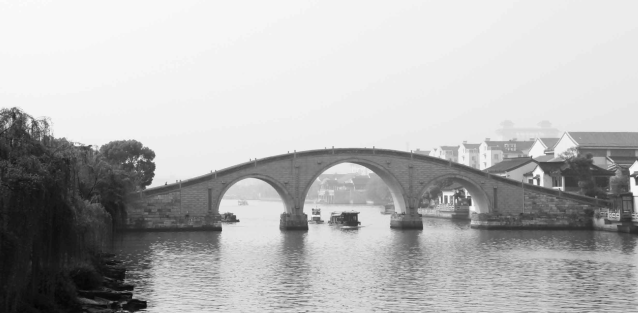
The Wannian Bridge spans over the moat outside Xumen Gate, connecting the central part of Xumen Road from east to west. Xumen Gate itself was situated outside the old city wall. According to Yuejue Shu (or The Glory of Yue: An Annotated Translation of the Yuejue Shu), a nine-bend road wound beyond Xumen Gate, which was laid by King Helv of Wu so that he could conveniently visited the Guxu Palace to enjoy views of Taihu Lake. The character “Xu” refers to a minister under Emperor Shun who aided Yu the Great in taming floods and was thus enfeoffed in the area of the Wu State (today there is still a Xuwang Temple, meaning “King of Xu” in Lake Tai). Thus, the area was named “Gu Xu” (meaning “ancient Xu”) which later evolved phonetically into “Gu Su.” However, the name “Xumen Gate” is recorded in Zuo Zhuan (or The Zhuo Commentary) and bears no connection with Wu Zixu. The Wannian Bridge was constructed in the 5th year of Emperor Qianlong’s reign (1740). During Emperor Kangxi and Emperor Qianlong’s reigns, Suzhou’s economy thrived, with tens of thousands of vessels traversing its waterways every day. Ferries struggled to meet demands of the travelers. Therefore, the local gentry raised funds and proposed the construction of Xumen Gate on multiple occasions. However, the local magnates and compliant officials who monopolized the ferry profits spread superstitions that there were quite a number mountains west of the city, which made a source of noxious energies. Building a bridge would channel these malign forces into the city, and there would be disasters. In 1740, Prefect of Suzhou Wang Dexin, defied these misleading ideas. With the support of Provincial Governor Xu Shilin, he ordered the construction of the Wanian Bridge which took two years to complete. This three-arch stone bridge featured wooden beams, whose foundation and two rectangular piers in the river were all built of granite. Supported by massive fir timbers, its superstructure features a level deck with square openings. The bridge measures 108.7 meters in length, 8 meters in width, and 11.3 meters in height. Fifty-three stone steps were set to each sloping approach. A stone memorial gateway inscribed “Foremost Bridge of the Three Wu Regions” was erected at the western end, flanked by two square stone pavilions.
The Wannian Bridge underwent major renovations during in the 25th year of Emperor Jiaqing’s reign (1820), the 1st year of Emperor Xianfeng’s reign (1851), and the 1st year of Emperor Tongzhi’s reign (1862) of the Qing Dynasty respectively. To facilitate vehicle access, the western approach was converted into a ramp while two concrete tracks were installed on the eastern stone steps in the 25th year of the Republican era (1936). The stone memorial gateway was dismantled during this period as well. After the Japanese occupation of Suzhou in 1937, the eastern steps and tracks were replaced by a cobblestone ramp. Subsequent repairs took place in the 28th (1939) and 29th (1940) year of the Republican period. Additional timber hanging beams were installed onto the existing wooden framework, including the girders, decking, and both sides of the bridge. On June 8, the 33rd year of the Republican period (1944), the bridge collapsed under the weight of a coal-laden Japanese military truck crossing it from west to east. It was rebuilt in 1952 as a three-arch reinforced concrete girder bridge with a length of 42 meters, a width of 6.4 meters, and iron railings. It has a central span with a 4-metre rise and a 14.5-meter clearance, flanked by two side spans each of 10 metres. In 2002, the bridge was declared as an unsafe one. The municipal government decided to demolish and rebuild the bridge in 2004 by preserving the original stone piers while replacing the concrete deck with a three-arch stone structure. The new bridge is 85 metres long and 6.2 meters wide, whose central span measures 16 meters while the two side spans each span 11.2 meters. It features solid-panel railings and stepped approaches on both the east and west slopes, 56 steps on the east and 65 on the west. There is a bridge abutment on the eastern approach. On either side of the abutment lay eight steps, bearing ornamental pillars with couplets composed during Emperor Qianlong’s reign. The two on either side of the arch were dated as “on an auspicious day in the 10th month in the Gengshen Year (1740) of Emperor Qianlong’s reign,” reading “Auspicious mists gather near River Han’s shore; imperial grace surge forth to rivers and lakes afar.” On the central one, the visitor may find, “Fine views are written into poems, beyond city walls one taking in view green peaks and emerald trees along the shore; the moon, a jade mirror, holds its own image, keeping company with itself atop the tower and Lord Wu’s surging tide on the river.” The two on either side of the northern facet of the arch, bearing the lines: “Painted boats ply the clear autumn water; a dark dragon rests on the steady night tide.” The central one carries the line: “Nature’s splendor through four seasons flows into the artist’s scroll; renowned across the Three Wu region, it stands as the first bridge to Xumen Gate Pass.” The railings were laid with city wall bricks. On the west side of the Wannian Bridge stands the Suzhou Urban Planning Exhibition Hall, a classical architectural complex with Suzhou characteristics which served as the venue for the 28th Session of the World Heritage Committee.