As chronicled in Records of Wu (Wu Di Ji), the capital city built by King Helv of Wu was designed to be surrounded by “eight land gates, aligning the Eight Winds of Heaven; and eight water gates, corresponding to the Eight Trigrams of Earth.” The eight land gates are Changmen Gate and Xumen Gate in the west, Panmen Gate and Shemen Gate in the south, Loumen Gate and Jiangmen Gate in the east, and Pingmen Gate and Qimen Gate in the north. Names for the eight gates varied across historical records. According to A Sequel to the Illustrated Treatise of Wu Prefecture, there was no Pingmen Gate. But Fengmen Gate did exist. Pingmen Gate actually bore the alternative name Wumen Gate, yet both Pingmen Gate and Chimen Gate were not included in the above mentioned eight gates. During the Wu period, the gates on the east side of the city were locked, as a measure to prevent invasions conducted by the State of Yue. All the eight gates were open during the Tang Dynasty. In the early Northern Song Dynasty, Shemen Gate and Jiangmen Gate were filled and closed, leaving the six gates of Changmen Gate, Xumen Gate, Panmen Gate, Fengmen Gate, Loumen Gate, and Qimen Gate open for public use. In the Southern Song Dynasty, for the sake of defense, only five of the gates remained open. When the rebel leader Zhang Shicheng took Suzhou in the late Yuan Dynasty, he added Yuecheng (meaning “barbicans”) to the six gates. These barbicans were later dismantled after the Taiping Heavenly Army captured the city. These fortifications at the five gates, namely Fengmen Gate, Loumen Gate, Qimen Gate, Xumen Gate, and Changmen Gate, were restored when the Qing government recaptured the city.
During the Republican era, Jinmen Gate, Pingmen Gate, Xiangmen Gate, and Xinxumen Gate were successively opened or reopened. By the time of the city’s liberation in 1949, Suzhou had had ten city gates, namely Changmen Gate, Xumen Gate, Panmen Gate, Fengmen Gate, Xiangmen Gate, Loumen Gate, Qimen Gate, Pingmen Gate, Jinmen Gate, and Xinxumen Gate. Since the establishment of the People’s Republic of China, most of these gates were successively pulled down. The three remaining ones were Panmen Gate, Xumen Gate, and Jinmen Gate. In recent years, Suzhou has placed great emphasis on the protection and restoration of ancient city walls. With several conservation projects, six city gates—Changmen Gate, Xiangmen Gate, Pingmen Gate, Loumen Gate, Qimen Gate, and Fengmen Gate—along with parts of their wall sections have been restored. Suzhou City Wall Museum was opened to the public in 2013.
Xiangmen Gate
Xiangmen Gate, originally named Jiangmen Gate (meaning “craftsmen’s gate”), is located in the east of Suzhou. It earned its name from being an area where a wide assortment of artisans and craftsmen once gathered. Legend has it that King Helv of Wu State ordered the master swordsmith Gan Jiang to set up a furnace here and cast swords. That’s why it is also known as Ganjiang Gate. The later name “Xiangmen” is the result of a phonetic shift. The gate was sealed up the early Song Dynasty and reopened between the 23rd and 25th years of the Republican era. It was demolished after the founding of the People’s Republic of China. In 2012, the gate was reconstructed as part of the second phase of Suzhou’s Ancient City Wall Restoration and Conservation Project.
A Selection of Poems on Xiangmen Gate
Seeing off Li Lu, a Provincial Graduate, to the Imperial Examinations
Liu Yuxi
Who feels sorry for the young noble gazing at autumn hills in silence?
Though born into a silk-clad family, he studies with earnest wills.
He aims to bring glory to his family by earning himself fame; so he gave up his official career to pursue learning.
We wait in quiet confidence for his laurel crown in the coming year; then his parents’ faces will beam with smiles.
Writing Poems on Drinking Wine as Matching Responses to Tao Yuanming’s Works (XVIII) (Fragment)
Huang Zhuolai
In obscurity I ponder the king’s grace;
My heart withdraws into its quiet.
When Lord Guan Zhong was freed from shackles,
A screen wall was erected before his house gate to celebrate his power.
A Collection of Old Photos of Xiangmen Gate
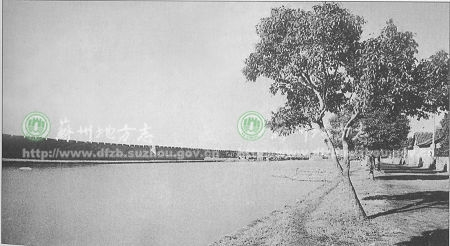
▲ The City Wall of Xiangmen Gate and the Moat
The city wall of Xiangmen Gate and its moat are located outside Xiangmen Gate. This photo was taken in 1951 by Gu Jiegang, Shen Weijun, and Wu Yucang when the three of them explored ancient places in Suzhou.
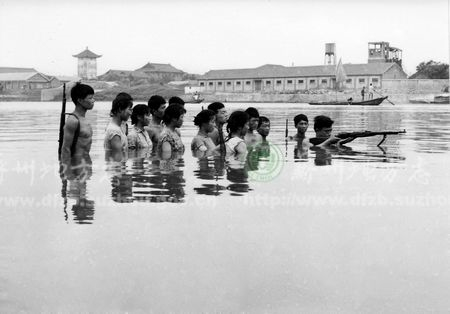
▲ Practice of Target Shooting on Water (taken in the 1970s)
The photo captures the scene when a basic unit of Suzhou’s militia drilled in targeting shooting on water in the moat by Xiangmen Gate.
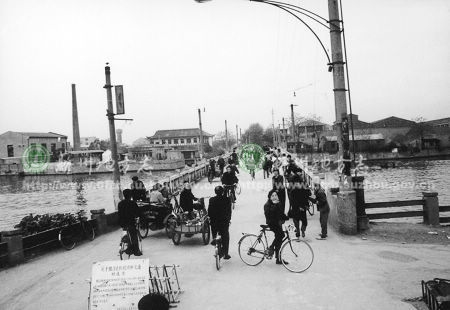
▲ Xiangmen Bridge
In the 24th year of the Republican era (1935), Xiangmen Gate was reopened while the Su-Jia Railway was under construction. A 13-span wooden bridge supported by concrete piers was built across the outer moat and named the Xinhua Bridge. In August 1937, the bridge was destroyed in a Japanese air raid. Xiangmen Gate was then sealed. The bridge was rebuilt as a reinforced concrete structure around 1958. It was reinforced and widen of 9.5 meters and lengthened to 129.8 meters in 1981. The old bridge was later demolished in 1993 during the construction of Ganjiang Road.
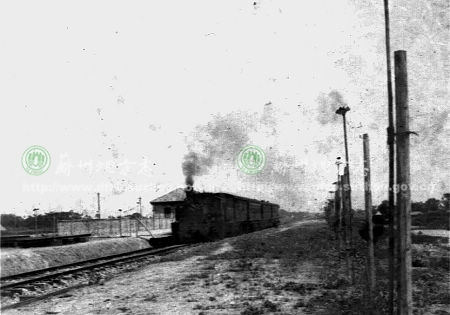
▲ Xiangmen Railway Station (taken during the Republican era)
The construction of the Su-Jia Railway began in February of the 24th year of the Republican era (1935). The railway became operational on July 15, 1936. This picture shows the Xiangmen Railway Station along the Su-Jia Railway. The railway was ripped up forcibly by the Japanese army in the 33rd year of the Republican era (1944). The photo was taken during the Republican period.
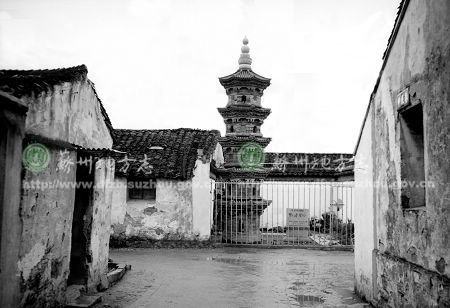
▲ Jiachen Lane Brick Pagoda
The Jiachen Lane Brick Pagoda is located at the Shiqiaotou area of Jiachen Lane, near Xiangmen Gate. It is said that the old city area of Suzhou used to have “seven pagodas and eight small brick pagodas.” Among the eight brick pagodas, only the one in Jiachen Lane has survived. Originally situated along the street, it was later enclosed within a residential complex. Rumor has it that the pagoda was built by Liu Bowen in the early Ming Dynasty. However, according to research by cultural relics authorities, it was used for storing sacred texts from the Song Dynasty. Before the War of Resistance against Japanese Aggression, the riverbank beside the pagoda was a vacant plot. On the nights of the 15th to the 30th of the seventh lunar month every year, the custom of “burning incense around the pagoda” was observed. Local people would gather here with paper effigies of ghosts and deities. During the ceremony, incense would be offered and lanterns were lit. The scene appeared lively yet eerie. The pagoda was restored in the 1980s. The picture shows the pagoda around its renovation.
A Selection of Photos of Present-Day Xiangmen Gate

▲ Xiangmen Gate by Night
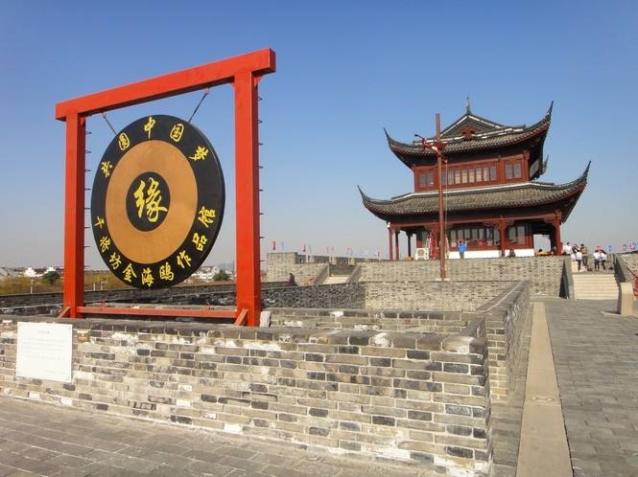
▲ The Tower of Xiangmen Gate
An Introduction to the Jiachen Lane Brick Pagoda
The Jiachen Lane Brick Pagoda is situated at Shiqiaotou in Jiachen Lane, along Ganjiang Road. The pagoda stands inside Xiangmen Gate of Suzhou, Jiangsu Province. It was designated as a municipal cultural relic protection unit in 1982. The status was elevated to that of an important national cultural relic protection unit in 2013. The brick pagoda, with its long history and simple yet elegant look, makes a convincing testament to the intelligence and craftsmanship of laboring people in ancient China. In modern times, it proves to be an excellent example for studying ancient architecture.
According to Wumen Biaoyin (meaning “an account of Suzhou’s hidden history, which claimed to be a complimentary record to Suzhou’s local gazetteer”), there used to stand seven small brick pagodas in the city area of Suzhou, most of which were built in the Song Dynasty. Among them, two were destroyed at a very early time, and another two were destroyed during Emperor Qianlong’s reign of the Qing Dynasty. Baita Pagoda (meaning “the white pagoda”) was dismantled in 1928 while Lindun Road underwent a widening project. The one at Lianxi Lane was dismantled as well in the 1950s when the road was being widened. The only surviving pagoda, recorded in Wumen Biaoyin as Number 2 of the “Seven Pagodas in the City,” was located “east of the Mengzi Hall.” It is now referred to as the Jiachen Lane Brick Pagoda.
The pagoda features a five-story, octagonal, pavilion-style brick structure which resembles a timber-frame tower. It stands 6.82 meters high. Each side of the base measures 0.51 meters in width, with a diameter of 1.2 meters. The intermediate eaves and mezzanine are formed by alternating courses of diagonal brickwork and corbelling. Bracket sets at the corners as well as architraves and column-top tie beams, are subtly shown on the wall surface beneath the eaves. On each of the eight sides, arched doorways and lightly recessed latticed windows alternate, whose arrangement rotates from floor to floor. The interior square chamber rotates 45 degrees with each successive floor. The sober elegance of the pagoda is achieved with the plain brick structure free from any decorative finish. It showcases simple, unpretentious yet classic beauty.

Present-day Jiachen Lane Brick Pagoda