


As chronicled in Records of Wu (Wu Di Ji), the capital city built by King Helv of Wu was designed to be surrounded by “eight land gates, aligning the Eight Winds of Heaven; and eight water gates, corresponding to the Eight Trigrams of Earth.” The eight land gates are Changmen Gate and Xumen Gate in the west, Panmen Gate and Shemen Gate in the south, Loumen Gate and Jiangmen Gate in the east, and Pingmen Gate and Qimen Gate in the north. Names for the eight gates varied across historical records. According to A Sequel to the Illustrated Treatise of Wu Prefecture, there was no Pingmen Gate. But Fengmen Gate did exist. Pingmen Gate actually bore the alternative name Wumen Gate, yet both Pingmen Gate and Chimen Gate were not included in the above mentioned eight gates. During the Wu period, the gates on the east side of the city were locked, as a measure to prevent invasions conducted by the State of Yue. All the eight gates were open during the Tang Dynasty. In the early Northern Song Dynasty, Shemen Gate and Jiangmen Gate were filled and closed, leaving the six gates of Changmen Gate, Xumen Gate, Panmen Gate, Fengmen Gate, Loumen Gate, and Qimen Gate open for public use. In the Southern Song Dynasty, for the sake of defense, only five of the gates remained open. When the rebel leader Zhang Shicheng took Suzhou in the late Yuan Dynasty, he added Yuecheng (meaning “barbicans”) to the six gates. These barbicans were later dismantled after the Taiping Heavenly Army captured the city. These fortifications at the five gates, namely Fengmen Gate, Loumen Gate, Qimen Gate, Xumen Gate, and Changmen Gate, were restored when the Qing government recaptured the city.
During the Republican era, Jinmen Gate, Pingmen Gate, Xiangmen Gate, and Xinxumen Gate were successively opened or reopened. By the time of the city’s liberation in 1949, Suzhou had had ten city gates, namely Changmen Gate, Xumen Gate, Panmen Gate, Fengmen Gate, Xiangmen Gate, Loumen Gate, Qimen Gate, Pingmen Gate, Jinmen Gate, and Xinxumen Gate. Since the establishment of the People’s Republic of China, most of these gates were successively pulled down. The three remaining ones were Panmen Gate, Xumen Gate, and Jinmen Gate. In recent years, Suzhou has placed great emphasis on the protection and restoration of ancient city walls. With several conservation projects, six city gates—Changmen Gate, Xiangmen Gate, Pingmen Gate, Loumen Gate, Qimen Gate, and Fengmen Gate—along with parts of their wall sections have been restored. Suzhou City Wall Museum was opened to the public in 2013.
Qimen Gate
Qimen Gate is situated in the northern part of Suzhou. The Gate derived its name from its ancient position facing the State of Qi. It is said that in the 10th year of King Helv’s reign (505 BC), the Wu State defeated State of Qi. The king of the Qi State gave a princess in marriage to the Crown Prince Bo of the State of Wu. Overwhelmed by homesickness, the princess shed tears all day long and fell ill. To comfort her, King of Wu gave an order to build this gate, and named it "Wangqi Gate" (meaning “a gate where one can gaze toward the State of Qi”). Then he invited the princess to go up the gate to enjoy herself and later the name was changed into Qimen Gate. As another story accounts it, the State of Wu was rather strong while the State of Qi remained weak. The aged King Jing of Qi gave his daughter to Wu’s Crown Prince Bo out of fear for the king’s authority. Unfortunately, the prince died an untimely death. The princess became heavily homesick in her grief. Then the king had a nine-story tower built atop Qimen Gate, so the princess could ascend and gaze toward her distant homeland. That’s why the gate was also referred to as “Wangqi Gate.” It is attested that Qimen Gate had a defensive outer barbican known as a battlement. A square-cornered wall links the inner and outer structures of the Gate. Qimen Gate had three successive gateways. On the western side of the inner gate was a water gate, over which a two-story tower was erected, commonly known as the Drum Tower. The gate complex had an inner moat and an outer one. The space between the walls was about twenty to thirty metres. The three-gateway design resulted in a zigzag route, which impeded traffic flow. The gate tower was dismantled in the early 1950s, followed by the demolition of the water gate when a sluice gate was constructed in 1978. In 2011, Suzhou launched the Ancient City Wall Restoration and Conservation Project, executed in batches, which restored the site of Qimen Gate Tower and part of the city wall around the gate.
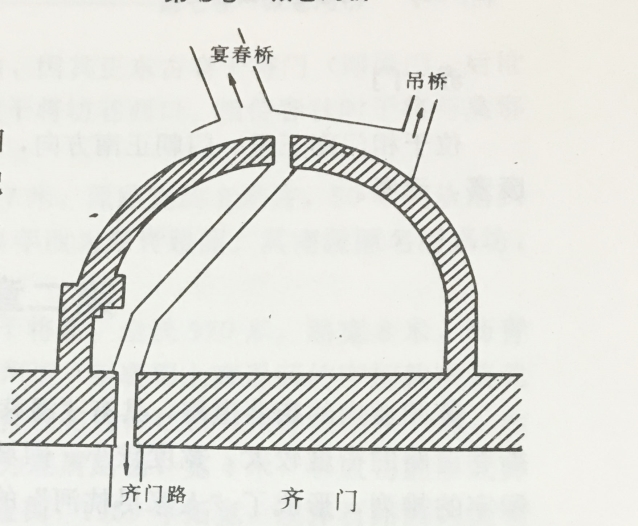
▲ Diagram of Qimen Gate
A Selection of Poems on Qimen Gate
In Grateful Reply to Scholar Mai: Three Quatrains (III)
Li Peng
All my life I’ve stood with my zither at Qimen Gate, waiting for recognition;
I never compete with beauties in the palace of Wu, who boast their flawless look.
What I favor is the classic charm of ritual vessels of the Zhou and Shang Dynasties,
Only you know me well and come to console my troubled soul.
Seeing off Chen, Top Scholar of Metropolitan Exam, Back to Tongchuan
Poet-Monk Yuanzhao
You bought a house by the Boat Bridge and live there;
Where our deep bond allows us to share sincere thoughts.
Your children can learn the local tongue of Wu State;
But in your age, you miss home far beyond Qimen Gate.
The green tree shades now foreshadow your departure;
The swelling river holds traces of farewell.
Yet when neighbors gather in your place,
The shared joy surpasses that of the rustic haven known as Qiangcun Village.
Seeing off Zither Master Yang
Wang Ao
I pound my gown atop the city wall in autumn moonlight;
As a stranger here, my heart flies southward like a wild goose.
Palaces were erected in Yan, but where are the men who built them?
I played the lute by Qimen Gate, while things did not go my way.
Ancient tunes can’t be heard now, though the written scores remain;
My lute is still here, but its tuning-pegs are gone.
At our parting, what I can give you is nothing but famous verses;
Yet do not say that understanding friends are rare in this world.
Three Parting Poems for My Fellow Graduate Cheng Luping (III)
Deng Yunxiao
The world’s affairs and current moods grow new each day,
And dusts rise high on the frontier with warfare.
I’m too lazy to play my lute by Qimen Gate;
In tough times, I sigh in vain over the fate of Han-dynasty firewood.
But my seven-foot frame still houses a gallant spirit;
In my brief life, how dare I scheme for my own interests?
Just look at those restless souls who leap out of the smelting pot,
Could they ever compare to Governor of Huaixing, a sage ruling so well from his couch?
On Hearing a Taoist Nun Play the Reed Organ under the Moon (I)
Cheng Jiu
An orchid-soul stands out from worldly dust,
A fair bright moon shines in the vast sky.
Why didn’t you ascend Songshan Mountain,
But choose to play false tunes among poor flutists by Qimen Gate?
Song of the Narrow Lane
Hu Kui
At dawn I walk through the narrow lane;
At dusk I tread the path again.
Who says there’s no room for a carriage to pass through?
My two wheels roll alright from daybreak to nightfall.
Narrow as it is, the lane allows steady passage;
But a narrow mind is easily disturbed by a trivial matter.
We meet, yet remain as strangers,
As if separated by a river ten thousand miles wide.
The sudden gust sweeps all the fallen leaves away;
While my winter gowns are still tucked in my old trunk.
Don’t hold tight the flute of Qi’s court;
You’d better pluck the sword and sing to make your worth seen.
When a tiger roars, winds blow high from the mountain,
When a dragon rises, clouds accelerate to fill the sky.
Don’t say this lane is narrow and confined,
The way of truth lies broad for all.
To Huang Qiuyue (I)
Yan Fu
Xue’s man could only pluck his sword and sigh;
In the court of Qi State, many faked their flute tunes.
A girl in poverty pities her marriage as a plight;
A scholar in troubled times is ashamed of his learning.
Can the bitter plum survive?
Will the peach of immortality bear fruits?
The ancient scholar’s lament at Guangwu Mountain still makes sense now;
Since to whichever way I turn, I meet dead ends.
Taking a Trip from the Fengqiao Bridge to Wucongjing River on the 20th Day of the First Lunar Month
Li Chaoqiong
At dawn, my light boat passes by Qimen Gate,
I roamed the villages on the water east of the lake.
Though spring has come, the chill lingers and the wind blows strong,
A light rain falls and removes all the traces of snow on the ground.
Today the sound of oars hushed a thousand homes,
When will those in the humble cottages have more pants to wear and stay warm?
The plum blossoms on the wild shores keep their old promise;
Drawn by the fragrance, I pause my paddle and give in to a poetic impulse.
A Selection of Old Photos of Qimen Gate
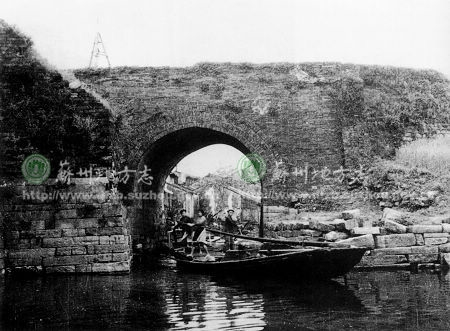
▲ The Water Gate of Qimen Gate
Qimen Gate was situated in the northern part of Suzhou. The name derives from its ancient position facing the State of Qi. In the early Qing Dynasty, the gate tower bore a plaque inscribed with “Chen Xin Gong Bei” (“臣心拱北,” meaning “loyalty to the emperor”). This photo was taken during the Republican era.
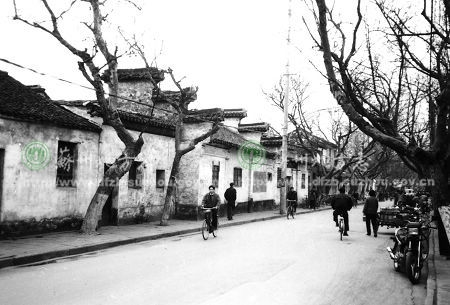
▲ Qimen Road (taken in the 1980s)
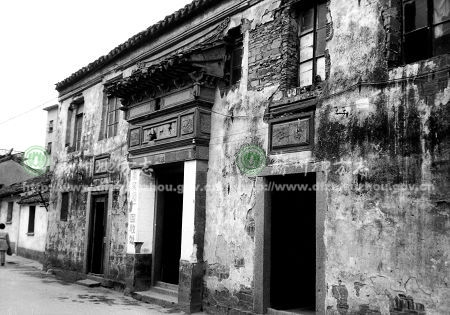
The historical building in the photo is the former residence of the Pans, known as Siji Hall (meaning “Hall of Reflection on Merits”) or Liugeng Hall (literally “Hall of Retaining the Family Tradition of Learning and Cultivation”), located at the original 84, Qimen Road.
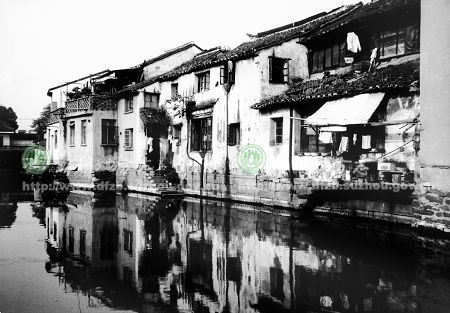
▲ Riverside Dwellings along Qimen Road (taken in the 1980s)
The riverside dwellings along Qimen Road appeared elegant and towering, featuring their unique styles respectively. They were demolished during the road-widening project in 1999.
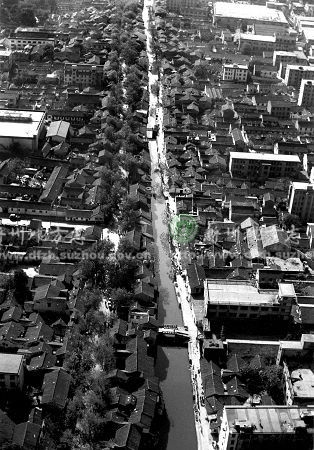
▲ An Aerial View of the Water Lane along Qimen Road (taken in the 1980s)
This water lane connected the outer moat beyond Qimen Gate in the north to the Lindu River in the south. Its banks were densely lined with residential buildings in a wide variety of styles, which formed a distinctive and picturesque waterscape. In 1999, all the waterside dwellings on the left side (as seen in this photo) were demolished for a road-widening project.
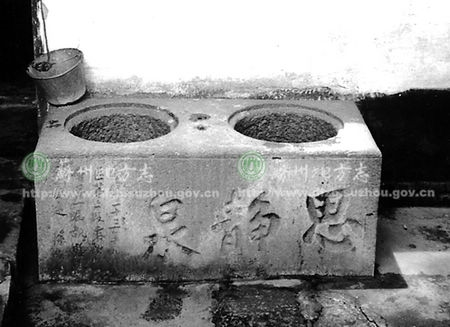
▲ Jingsi Spring (taken in the 1980s)
The Jingsi Spring (literally meaning “a spring of introspection”) is located at 15 Qimen Road. It has a granite wellhead.
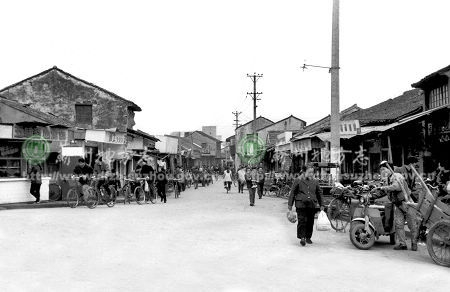
▲ Qimenwai Dajie (South)
Qimenwai Dajie (South) (meaning “South Street Outside Qimen Gate”) was demolished and reconstructed in 1999. This photo captures original view of the street during the 1980s.
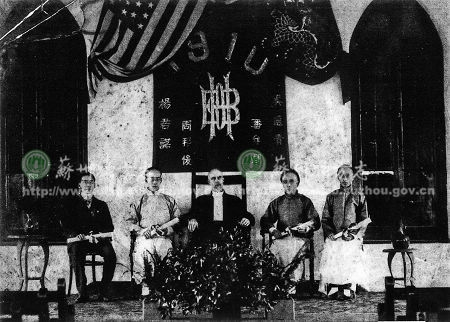
▲ Fuyin Hospital
Fuyin Hospital (meaning “Gospel Hospital”) was situated by Yangjintang River outside Qimen Gate. It was founded in the 21st year of Emperor Guangxu’s reign (1895) by American Presbyterian missionary Davis and American physician Dr. Wilkinson outside Qimen Gate. The hospital had Suzhou’s first psychiatric department dedicated to treating patients with mental illnesses. This photo, taken in the late Qing Dynasty, shows Dr. Wilkinson with his Chinese students.
▲ Site of the Former Anqi Wang Temple (taken in the 1980s)
There were two Anqi Wang Temples (meaning “the Temple of General Anqi”). One was located inside Qimen Gate, by the Yulangqiao River in the area known as Beiyuan (“the northern garden”). The other stood outside the gate on Donghui Road. The deity honored was An Wannian, a general who died when defending the city against Zhu Yuanzhang’s troops during an attack at Qimen Gate in the late Yuan Dynasty. In recognition of his sacrifice, the local community revered him as a protective deity. The temple was first built in the early Hongxi era of Ming Dynasty and later reconstructed during Emperor Tongzhi’s reign of the Qing Dynasty. This photo shows the former temple site at 68 Donghui Road, outside Qimen Gate.
A Selection of Photos of Present-Day Qimen Gate
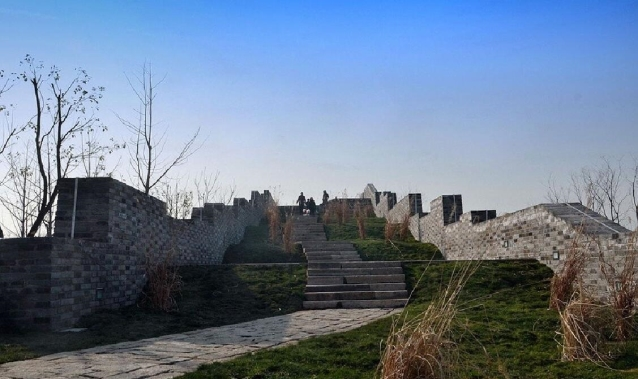
▲ The New Qimen Gate
An Introduction to the Jingsi Hall
The former residence of the Pans, known as Siji Hall (meaning “Hall of Reflection on Merits”) is located at 77-84 Qimen Road. The residence complex faces west and has two parallel axes, each with four rows of courtyards and a garden in the rare. The second courtyard along the northern axis houses the main hall, which features a Yingshan Ding (a type of flush gable roof). The façade of the hall is three bays wide, spanning 11.2 meters. The hall has a depth of 13.6 meters. The architrave of the hall is carved with bas-relief depicting scenes from traditional operas. The hall is adorned with a horizontal plaque inscribed with “Siji Hall”, dated to the 2nd year of Emperor Xuantong’s reign (1910). This plaque, crafted with characters inlaid in black jadeite, was regarded as the family’s most prized possession due to its exceptional value. The front façade is flanked by two “Jiaxiang” wings (or “two side rooms”). The third courtyard accommodates a Hualan Hall (meaning "Hall of Flower Baskets”), known for its exquisitely carve work. In the rear garden, a square pavilion and boxwood trees have been preserved. The western section faced the street and was demolished in 1999.
The owner, surnamed Pan, was from Jiangxi Province. The residence was initially constructed during the Guangxu era of the Qing Dynasty. Mr. Pan ran a porcelain business in Suzhou. In the mid-Qing Dynasty, he had this two-story building with two rows of courtyards. On the eve of liberation, Pan's descendants departed from the mainland. The property was later nationalized and allocated to a silk weaving factory, serving as both staff dormitories and a warehouse. The mansion was once converted into a restaurant.
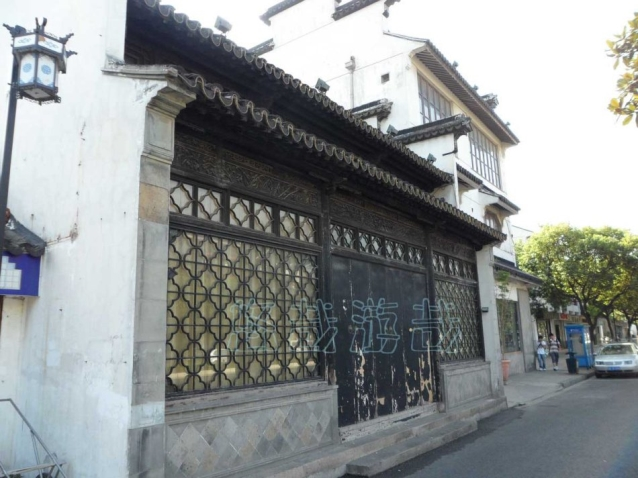
Today’s Siji Hall
