


As chronicled in Records of Wu (Wu Di Ji), the capital city built by King Helv of Wu was designed to be surrounded by “eight land gates, aligning the Eight Winds of Heaven; and eight water gates, corresponding to the Eight Trigrams of Earth.” The eight land gates are Changmen Gate and Xumen Gate in the west, Panmen Gate and Shemen Gate in the south, Loumen Gate and Jiangmen Gate in the east, and Pingmen Gate and Qimen Gate in the north. Names for the eight gates varied across historical records. According to A Sequel to the Illustrated Treatise of Wu Prefecture, there was no Pingmen Gate. But Fengmen Gate did exist. Pingmen Gate actually bore the alternative name Wumen Gate, yet both Pingmen Gate and Chimen Gate were not included in the above mentioned eight gates. During the Wu period, the gates on the east side of the city were locked, as a measure to prevent invasions conducted by the State of Yue. All the eight gates were open during the Tang Dynasty. In the early Northern Song Dynasty, Shemen Gate and Jiangmen Gate were filled and closed, leaving the six gates of Changmen Gate, Xumen Gate, Panmen Gate, Fengmen Gate, Loumen Gate, and Qimen Gate open for public use. In the Southern Song Dynasty, for the sake of defense, only five of the gates remained open. When the rebel leader Zhang Shicheng took Suzhou in the late Yuan Dynasty, he added Yuecheng (meaning “barbicans”) to the six gates. These barbicans were later dismantled after the Taiping Heavenly Army captured the city. These fortifications at the five gates, namely Fengmen Gate, Loumen Gate, Qimen Gate, Xumen Gate, and Changmen Gate, were restored when the Qing government recaptured the city.
During the Republican era, Jinmen Gate, Pingmen Gate, Xiangmen Gate, and Xinxumen Gate were successively opened or reopened. By the time of the city’s liberation in 1949, Suzhou had had ten city gates, namely Changmen Gate, Xumen Gate, Panmen Gate, Fengmen Gate, Xiangmen Gate, Loumen Gate, Qimen Gate, Pingmen Gate, Jinmen Gate, and Xinxumen Gate. Since the establishment of the People’s Republic of China, most of these gates were successively pulled down. The three remaining ones were Panmen Gate, Xumen Gate, and Jinmen Gate. In recent years, Suzhou has placed great emphasis on the protection and restoration of ancient city walls. With several conservation projects, six city gates—Changmen Gate, Xiangmen Gate, Pingmen Gate, Loumen Gate, Qimen Gate, and Fengmen Gate—along with parts of their wall sections have been restored. Suzhou City Wall Museum was opened to the public in 2013.
Panmen Gate
Located in the southwest of Suzhou, Panmen Gate was initially named “Panmen” (“蟠门,” meaning “coiled gate”) after the wooden coiled dragons carved on its frame, symbolizing the suppression of the State of Yue. Due to its unique layout of intertwined land and waterways, where “rivers wind their way,” it earned itself the name “Panmen” (Coiled Gate). The present gate structure is a relic rebuilt during the Yuan Dynasty and subsequently renovated in the Ming and Qing Dynasties. In the early Qing Dynasty, a gate tower was built with a plaque installed on which the four characters “Long Pan Shui Lu” (meaning “a coiled dragon over land and water”) were inscribed. The gate complex features water and land entrances side by side, including two land gates and two watergates. The area between the two land gates forms a “barbican.” The outer entrance of the land gate passage measures 3 meters in width and 7 meters in length, while the inner one is 4 meters wide and 15 meters long. The gate structure accommodates a narrow vertical channel for lowering the sluices. The small vacant lot between the inner and outer entrances, measuring 20 meters on each side, served as a trap for luring enemies to come in. Once inside, they would be attacked by a hail of arrows and stones from above and thus destroyed. For further defense, the gate was equipped with crenellations, parapets, and an inclined rampway (with a 20-degree incline, leading to the top). Each of the watergates had a double granite arch, supported by four massive stone pillars anchored on a stone foundation. Its passage was wide enough for two small boats to pass side by side. The watergates had no sluices.
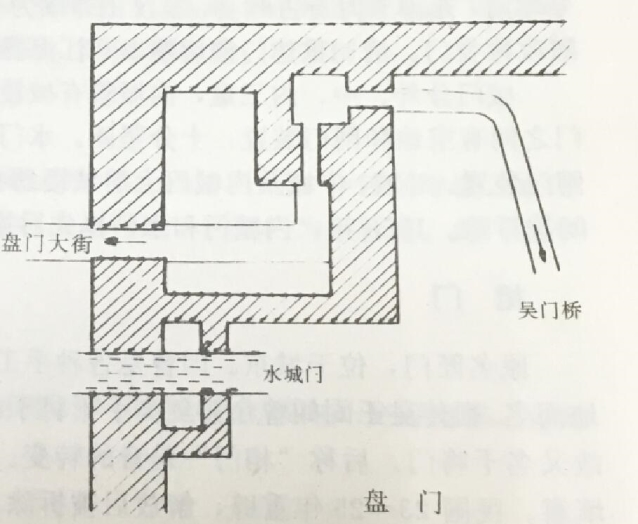
▲ Diagram of Panmen Gate
A Selection of Old Photos of Panmen Gate
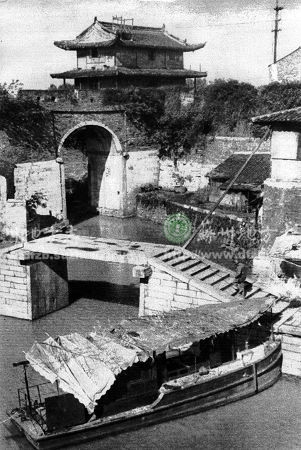
▲ The Panmen Gate Tower (1938)
Panmen Gate is situated in the southwest of the old city area of Suzhou. The gate complex features water and land entrances side by side, including two land gates and two watergates. The area between the two land gates forms a “barbican.” The gate was equipped with crenellations, parapets, and an inclined rampway (with a 20-degree incline, leading to the top). The original gate tower was destroyed during the War of Resistance against Japan Aggression. The year 1986 witnessed its reconstruction.
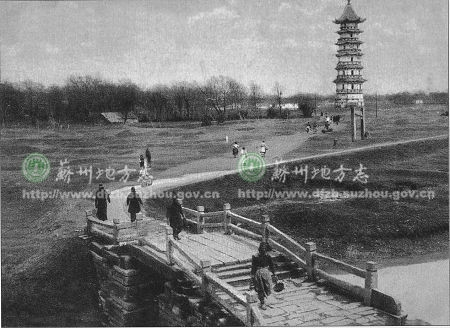
▲ At the Foot of Panmen Gate’s Wall (taken in the 1930s)
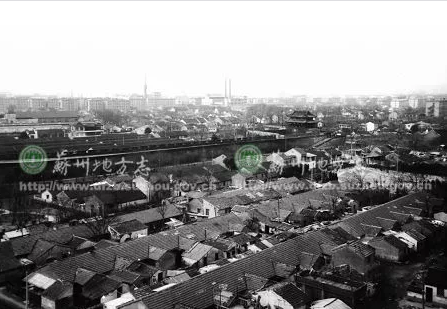
▲ At the Base of Panmen’s City Wall (taken in the 1980s)
During the Tang Dynasty, this area was known as Kunwei Lane, at whose western entrance stood a memorial archway. In the Song Dynasty, it was renamed Miaowan Lane, featuring rows of temples and residential houses lining along the street. The locality suffered devastation repeatedly and was reduced to ruins due to wars the Southern Song and late Yuan Dynasties as well as the early Qing Dynasty and Emperor Xianfeng’s reign of Qing Dynasty. The area was later converted into vegetable patches and farmland. In the early days of the People’s Republic of China, the local government built a residential complex for workers, known as Ruiguang Xincun Residential Area. Due to the development of the Panmen Scenic Area, the residential area was torn down in 1997.
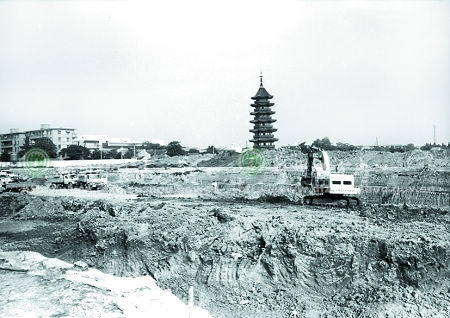
▲ The Panmen Scenic Area (taken in the 1980s)
This photo shows the area prior to the construction of the Panmen Scenic Area.
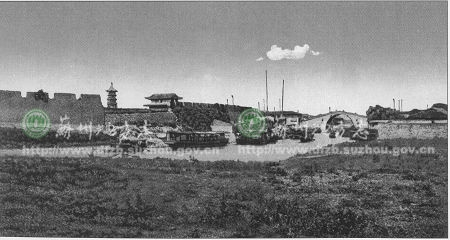
▲ The Three Attractions of Panmen Gate
The three attractions of this scenic area are Panmen Gate, Wumen Bridge, and the Ruiguang Pagoda. This photo was taken in the early years of the Republican era.
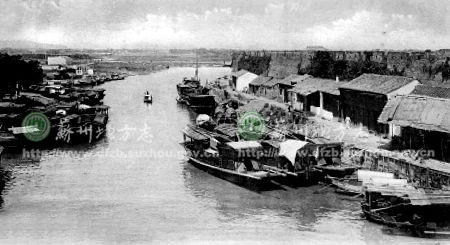
▲ The City Wall of Panmen Gate and the Moat (1928)
Suzhou has been repeatedly ravaged by wars since its establishment in the Spring and Autumn period. The city suffered particularly severe destruction in the early Sui Dynasty, the Southern Song Dynasty, and the Yuan Dynasty, during which it was brought to the verge of complete ruin. Yet restoration efforts invariably followed, allowing the city to survive and generally maintain its original scale and location for over 2,500 years. It is a real pity that most of the encircling city walls were regrettably demolished in the 1950s.
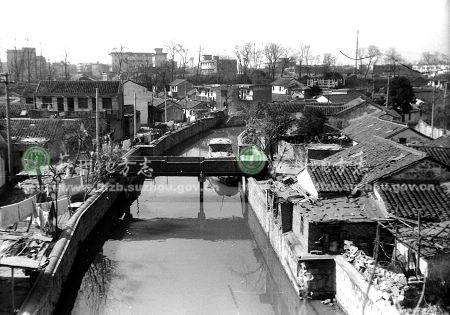
▲ Shuixiang Lane of Xidajie Street (Xingfu Village)
Shuixiang Lane of Xidajie Street (Xingfu Village) was located adjacent to the city wall of Panmen Gate. The area experienced demolition and the community here was relocated in 2000 during the development of the Panmen Scenic Area. The photo was taken in the 1980s.
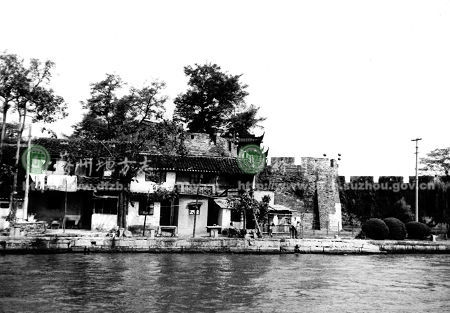
▲ Households at the Foot of Panmen Gate (taken in the 1980s)
During the period of the Taiping Heavenly Kingdom, the area outside Panmen Gate suffered repeated ravages of war and was reduced to barren land. In the late Qing Dynasty, migrants began to settle here. They built houses along the city wall and the moat. A bustling neighborhood was thus gradually formed. These dwellings were torn down in 1997 during the development of the Panmen Scenic Area.
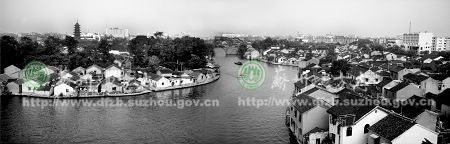
▲ A Bird’s Eye View of the Outer Moat at Panmen Gate (taken in the 1980s)
This photo captured a panoramic view of the moat surrounding Panmen Gate. Repeated wars gradually turned the moat banks barren. Later, migrants began to settle down here to make a living during the Republican era. A vigorous neighborhood thus formed and extended to the foot of the city wall. The houses along the riverbanks were pulled down in 2003 when the project of preserving the historic scenery around the old city area was launched.
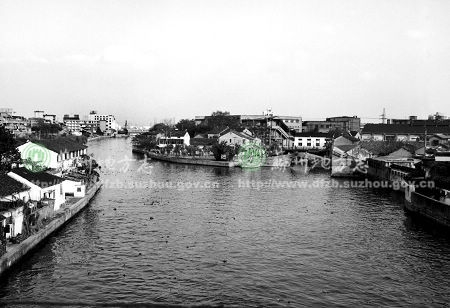
▲ The Outer Moat at Panmen Gate (taken in the 1980s)
This photo presents the river scenery east of the Wumen Bridge. The residential buildings on the left were on Guangyu Lane, while further back in the picture were the Xinglong Bridge and Yutang Bridge. In 2003, the three-arch Panlong Bridge was built north of Xinglong Bridge. This photo captures the scene prior to the construction of the Panlong Bridge.
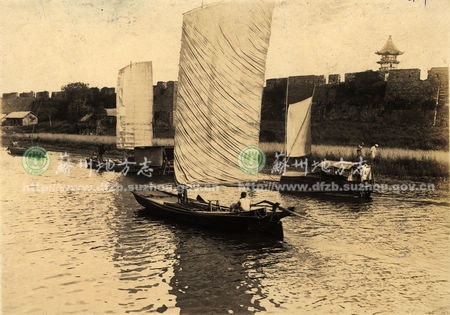
▲ The City Wall of Panmen Gate and the Moat (taken during the Republican era)
A Selection of Photos of Present-Day Panmen Gate
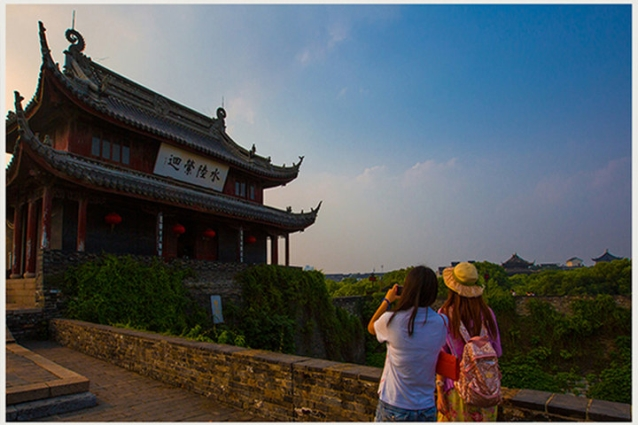
▲The New Panmen Gate
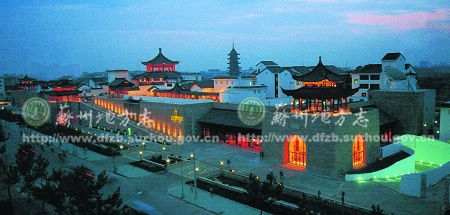
▲ The Panmen Scenic Area was completed and opened to the public for the 50th National Day in 1999. This photo was taken in 1999.
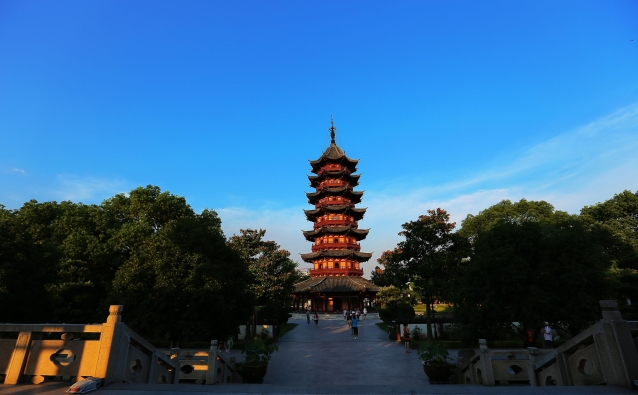
▲ Present-Day Ruiguang Pagoda
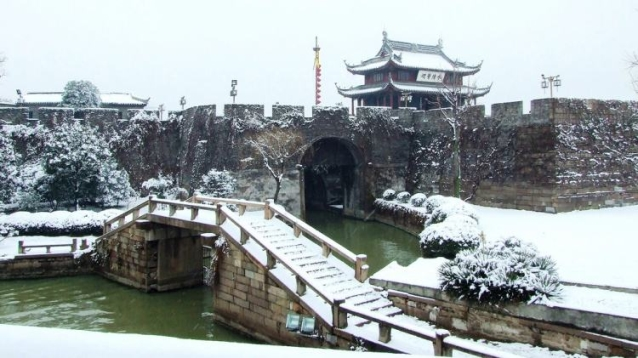
▲ Panmen Gate in Snow
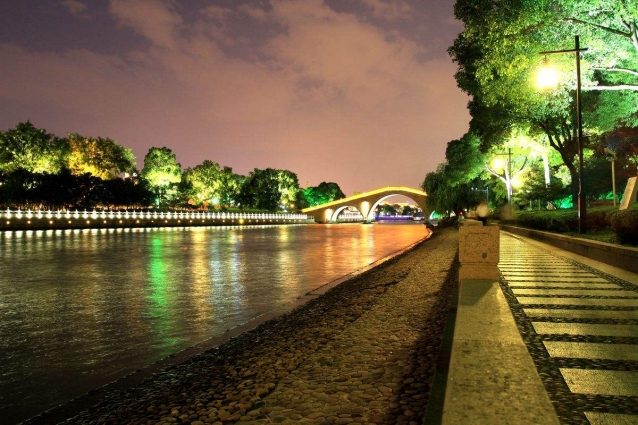
▲ Wumen Bridge by Night
A Selection of Poems on Panmen Gate
Approaching Panmen Gate at Dusk
Fan Chengda
Human voices sounded loud and gay while the evening breeze turned cool;
Through countless windows, lamplight lent life and joy to the river.
Two rows of green willows shaded the official ferry;
A cluster of red buildings rose above the parapet walls along the city ramparts.
I could hear water chestnut gatherers were singing somewhere;
The scent of incense told of a moon-worshipper making an offering somewhere.
In my light furs and on a fine horse, I idly crossed the marketplace;
Then, feeling weary, I leaned on my rush mat and sank into the realm of dreams.
Two Poems on Passing by Suzhou by Boat
Yang Wanli
Approaching Suzhou, our boat takes a sudden turn;
Panmen Gate was partially visible through the row of willows.
Keeping gazing ahead, I wondered when we would arrive;
All I could do was lean against the cabin window and watch the distant haze.
To Sikong Shu on His Departure for Suzhou
Miao Fa
This land by Panmen Gate once belonged to old Wu State,
Where cicadas fall silent when autumn cloaks the grass.
Those who leave for home have long been gone,
Yet you alone have delayed your move this long.
After a night’s stay on the river at Guangling,
At Jianye, a monk awaits your coming.
If you make it to the Qixia Temple,
Be sure to see the stele commemorating Jiang Zong.
Two Poems on the Waterway to Wusong (I)
Chao Buzhi
I moored my boat by the river,
And gazed around just to see a vast stretch of desolate land.
In the dusk, a fox cried loud by the graves;
Meanwhile, a village dog barked in the chill.
I set my sail and crossed the vast expanse of Taihu Lake;
Racing against the rain, I hurriedly entered Panmen Gate.
In sorrow, I pondered about King Fuchai’s deeds,
The hills of Wu now keep the Chu spirits sealed.
Mooring at Suzhou
Wang Anshi
At dawn I roamed east of Panmen Gate;
By dusk, I’d passed west of Changmen Gate.
I gazed around, catching no soul in sight,
But the pale sun sinking low.
The desolate woods wreathed in evening mist,
Above which homing birds were calling.
Everything in the world has found its place to rest,
But I still had nowhere to settle down.
An Introduction to the Ruiguang Pagoda
The Ruiguang Pagoda inside Panmen Gate was built during the Dazhong Xiangfu era (Emperor Zhengzong’s reign) of the Northern Song Dynasty (1008-1016). Legend has it that the Light of the Śarīra (sheli guang) shone from the pagoda was detected on several occasions. It was hence named Ruiguang Pagoda (meaning “Auspicious Light Pagoda”). This elegant seven-story, octagonal structure is a typical example of pavilion-style pagoda of brick and timber construction which was very popular in the area south of the Yangtze River during the Song Dynasty. Its height reaches 44.42 meters. The outer corridor surrounding the base of the pagoda was supported by stone Sumeru platforms, which were intricately carved with lions, mythical beasts, floral patterns, and cloud designs. The pagoda underwent conservation repairs in 1980 and has experienced restorative renovation since then. It is now listed as a provincial-level historical and cultural protection unit.
In April 1978, a collection of precious cultural relics dating back to the Five Dynasties period and the early Northern Song Dynasty was discovered in a brick niche located in the core of the third story. The findings included two gilded bronze pagodas; nine statues of deities such as Kṣitigarbha, Guanyin, and the Buddha; hand-copied sutras from the Five Dynasties, a woodblock-printed The Sūtra of the Lotus of the Wonderful Law from the Northern Song, and a lacquer sutra case inlaid with mother-of-pearl. Among these treasures, the most exquisite one was a “precious pearl-inlaid pagoda for housing Śarīra” with a height of 1.22 meters. Adorned with pearls and precious stones, it is a work involving a variety of artistic crafts including jade carving, gold and silver work, wood carving, gilt painting, and lacquer art. That’s why it has been recognized as a priceless treasure. These artifacts hold significant value for researching the social development and artistic achievements of the Song Dynasty. Moreover, they serve as evidence to confirm that the existent brick structure of the pagoda dates back to the second year of the Dazhong Xiangfu era of the Northern Song Dynasty (1009).
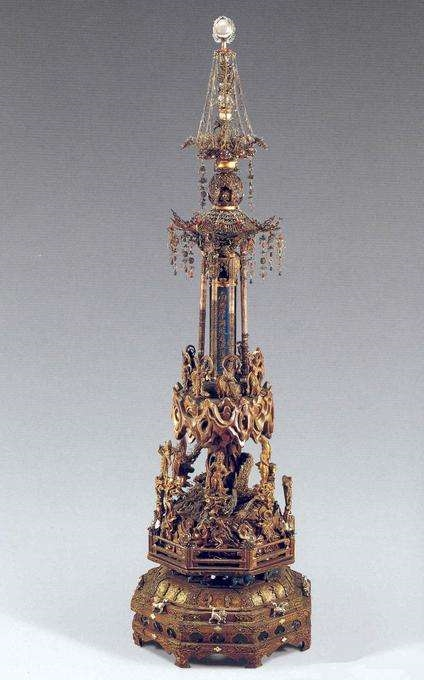
The Śarīra Reliquary Pagoda Decorated with Pearls
