As chronicled in Records of Wu (Wu Di Ji), the capital city built by King Helv of Wu was designed to be surrounded by “eight land gates, aligning the Eight Winds of Heaven; and eight water gates, corresponding to the Eight Trigrams of Earth.” The eight land gates are Changmen Gate and Xumen Gate in the west, Panmen Gate and Shemen Gate in the south, Loumen Gate and Jiangmen Gate in the east, and Pingmen Gate and Qimen Gate in the north. Names for the eight gates varied across historical records. According to A Sequel to the Illustrated Treatise of Wu Prefecture, there was no Pingmen Gate. But Fengmen Gate did exist. Pingmen Gate actually bore the alternative name Wumen Gate, yet both Pingmen Gate and Chimen Gate were not included in the above mentioned eight gates. During the Wu period, the gates on the east side of the city were locked, as a measure to prevent invasions conducted by the State of Yue. All the eight gates were open during the Tang Dynasty. In the early Northern Song Dynasty, Shemen Gate and Jiangmen Gate were filled and closed, leaving the six gates of Changmen Gate, Xumen Gate, Panmen Gate, Fengmen Gate, Loumen Gate, and Qimen Gate open for public use. In the Southern Song Dynasty, for the sake of defense, only five of the gates remained open. When the rebel leader Zhang Shicheng took Suzhou in the late Yuan Dynasty, he added Yuecheng (meaning “barbicans”) to the six gates. These barbicans were later dismantled after the Taiping Heavenly Army captured the city. These fortifications at the five gates, namely Fengmen Gate, Loumen Gate, Qimen Gate, Xumen Gate, and Changmen Gate, were restored when the Qing government recaptured the city.
During the Republican era, Jinmen Gate, Pingmen Gate, Xiangmen Gate, and Xinxumen Gate were successively opened or reopened. By the time of the city’s liberation in 1949, Suzhou had had ten city gates, namely Changmen Gate, Xumen Gate, Panmen Gate, Fengmen Gate, Xiangmen Gate, Loumen Gate, Qimen Gate, Pingmen Gate, Jinmen Gate, and Xinxumen Gate. Since the establishment of the People’s Republic of China, most of these gates were successively pulled down. The three remaining ones were Panmen Gate, Xumen Gate, and Jinmen Gate. In recent years, Suzhou has placed great emphasis on the protection and restoration of ancient city walls. With several conservation projects, six city gates—Changmen Gate, Xiangmen Gate, Pingmen Gate, Loumen Gate, Qimen Gate, and Fengmen Gate—along with parts of their wall sections have been restored. Suzhou City Wall Museum was opened to the public in 2013.
Pingmen Gate
Pingmen Gate is located in the northern part of Suzhou, to the west of Qimen Gate. There are two theories regarding the origin of its name. One suggests that it was named to express the intention to conquer the State of Qi. The other claims that it was from this gate that Wu Zixu’s army marched out on a campaign to subdue the State of Qi and later re-entered the city via this very gate after vanquishing Qi, hence the name. The exact time when the ancient Pingmen Gate was abandoned and blocked remains unknown. In the 17th year of the Republic of China era (or 1928), to facilitate transportation between the inner and outer city, Pingmen Gate was reopened, featuring two grand, side-by-side gateways. It had an outer moat but no inner one. There was neither a gate tower on it nor any water gate. Pingmen Gate was demolished in 1958. In 2012, the gate and part of its city wall were reconstructed as part of a project to restore and preserve the ancient city wall in Suzhou.
A Selection of Poems on Panmen Gate
In Reply to Assistant Han of the Treasury
Wei Yingwu
A noble man is free from worldly concerns,
He is beyond both fame and shame.
Casting off the glorious official hat,
He intends to retreat to the quiet woods to live.
Though still holding a lingering attachment to the life at court,
He is glad to be away from mundane cares.
Leisurely I observe the flow of fate;
Who can tell when the first sign appears?
How could I claim to be a noble man,
When I live west of Pingmen Gate in retreat?
As a man of dull wit I was abandoned by the world,
I’d follow Jie Ni and Chang Ju’s example to plough the fields.
The wind piles snow through the depth of night,
The field path is overgrown and lies bare to sight.
I’m so glad to receive your letter,
And hope we’ll meet and have a heartfelt talk.
Sharing My Thoughts with My Fellow Graduates after Crossing Pingmen Bridge on My Way to Assume Office in West Chuan
Wu Rong
The river runs eastward beneath Pingmen Bridge;
When I take a glimpse at my long march to the frontier.
Homesickness arises where lush grass grows;
Only the setting sun knows my boundless sorrow.
The Qin tombs, bare of trees, are shrouded in mist;
The walls of Han gardens stand bare, beaten by waves from the river.
I keep looking back not because I lament over the past spring,
But because the debt of gratitude is heavy, which even makes my horse reluctant to advance.
Elegy for My Cousin Chen Jingshao (II)
Wang Shipeng
With a sigh, I regret that few of my old friends are with me now;
Now you’ve become one of those who are gone before me.
Beyond Pingmen Gate, nowhere can I find your carriage tracks;
And your guest couch now gathers dust.
Your constant kindness made me feel ashamed,
Since I knew too well, like Guan Zhong, you don’t have much to spend.
All those places where we talked and shared our laugh,
When I recall them, grateful tears soaked my handkerchief.
Buddhist Dancers—Weary Farewell at Pingmen Gate
Wang Luyi
My spring gown brushed through blossoms white as snow;
The east wind starts to blow in early March.
Beyond the bridge there stood Pingmen Gate.
Now at middle age, I see what I owe my parents.
The thin quilt and midnight wine made me tired,
Upon my departure, I kept looking back at willows in farewell.
In the morning rain, willow branches form a green cloud hanging low;
My gown is damp, yet the one I’m waiting for hasn’t come back.
Song of the Red Peach Blossoms: Accompanying My Teacher Shuangya to Seek Peach Blossoms outside Taiping Gate
Lu Qian
Don’t say our robes are too light and thin;
Don’t fail to keep our engagement to meet spring blossoms.
In the area south of the Yangtze River, willows turn the city green in March.
Green hills appear bright and fair.
Peach blooms spread far and wide;
Let’s drink to our heart’s content before these flowers.
In the empty sky orioles sing their songs aloud.
Tree branches hold high crimson velvety floss.
It’s the herb-gaming days, and no fire is allowed;
What gleams is golden towers and white pavilions.
How I l envy the miles of ladies dressed in their finery,
Their “Song of Welcoming Spring” ring clearly through the town.
Two Impromptus on Gusu (II)
Wu Wenzhi
A sail so light that it sways in the evening breeze;
At Hanshan Temple, no bell is heard in the midnight.
I inquire about where the old poet has gone,
When the bridge arches like a rainbow, the moon bends like a bow.
A Selection of Old Photos of Pingmen Gate
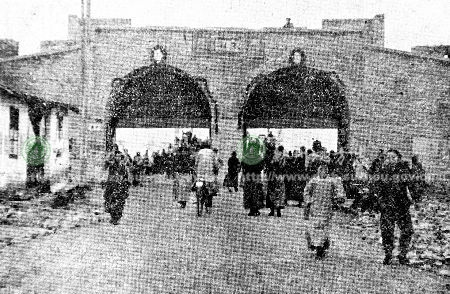
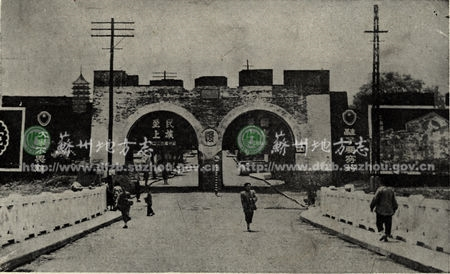
▲ Pingmen Gate
Pingmen Gate was located in the northern part of Suzhou. Legend has it that Wu Zixu’s army marched out through this gate to conquer the State of Qi, and returned victoriously via the very gate, hence the name “Pingmen” (literally “gate of pacification”). The ancient gate had long been blocked. In 1928, it was reopened to improve transportation, but later was demolished in 1958. The photos below show Pingmen Gate in different periods: the newly completed Pingmen Gate in 1929; Pingmen Gate under Japanese occupation in 1938; the gate after the victory in the War of Resistance in 1947; and Pingmen Gate in 1950 after the founding of the People’s Republic of China.
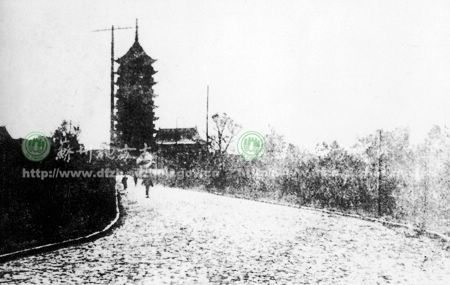
▲ Pingmen Dadao
This photo shows the newly opened Pingmen Dadao in late 1927. The ancient pagoda in the background is the Beisi Pagoda (also known as the North Temple Pagoda).
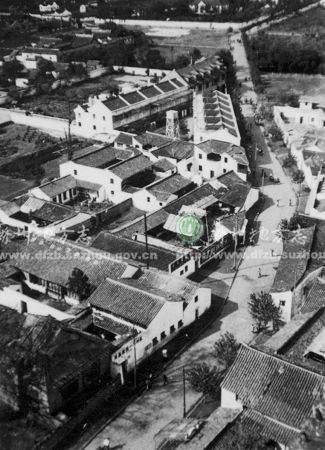
▲ A Bird’s-eye View of Pingmen Dadao
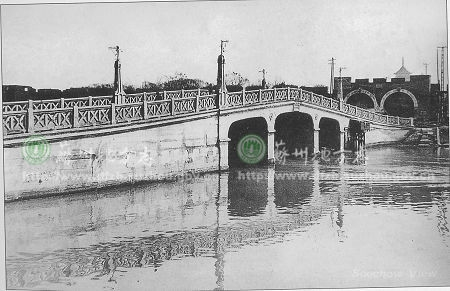
▲ Meicun Bridge at Pingmen Gate
The Meicun Bridge was funded and built by Bei Litai in 1929, who named it after his father, Bei Jinen. The picture was taken during the Republican period.
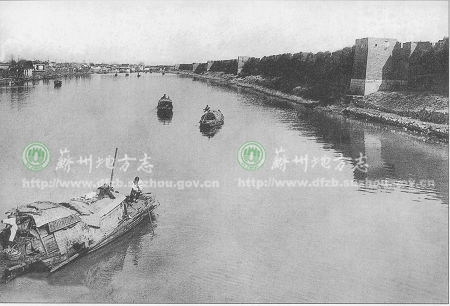
▲ The City Wall of Pingmen Gate and the Moat (taken in the 1930s.)
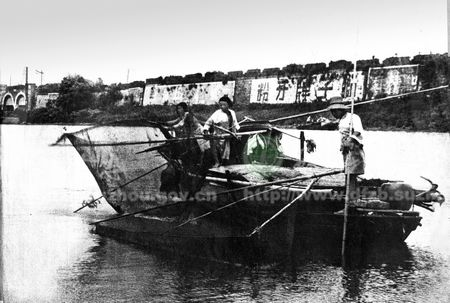
▲ The Moat around Pingmen Gate (1938)
Pingmen Gate, constructed in 1927, featured a double-arch gateway. The Meicun Bridge was added in 1929, which connected the railway station with the inner city. This photo, taken in 1938, captures a fishing boat on the moat, and in the background is the time-worn city wall on which one can see a succession of outdoor commercial billboards.
A Selection of Photos of Present-Day Pingmen Gate
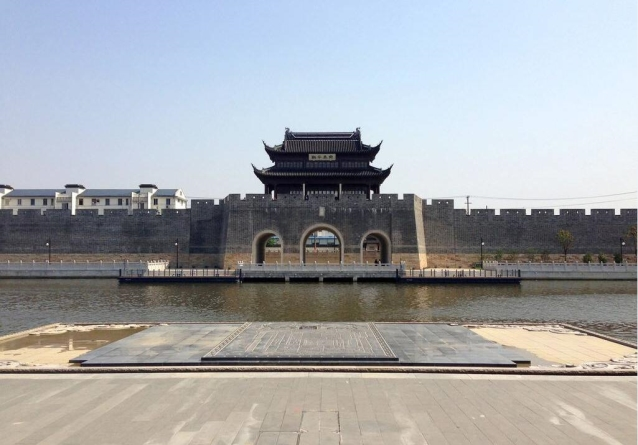
▲The New Pingmen Gate
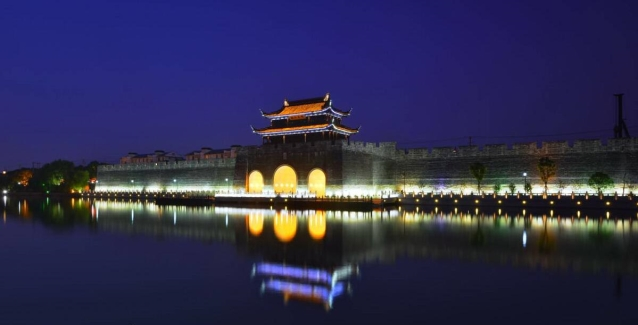
▲ Pingmen Gate by Night
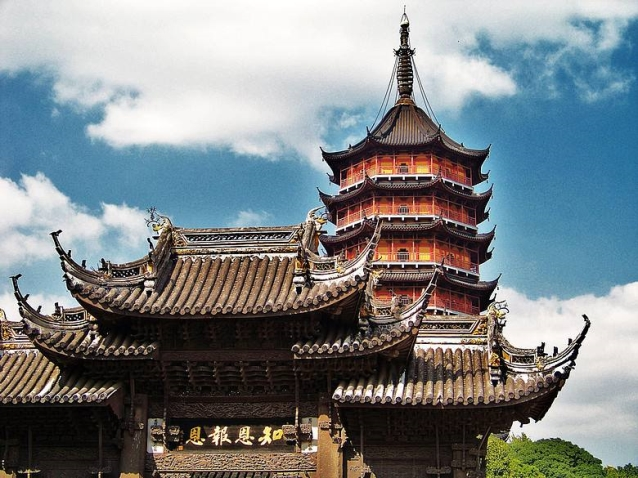
An Introduction to the Beisi Temple (the North Temple Pagoda)
The Bao’en Temple in Suzhou, historically named the Bao’en Wansui Xianshou Jiao Temple (meaning “the Monastery of Repaying Kindness and Eternal Blessings, dedicated to the Huayan School of Buddhism”) and also known as the Bao’en Lecture Temple (meaning “the Lecture Monastery of Repaying Kindness”), is commonly called the North Temple. The site originally housed the Kaiyuan Temple of the Tang Dynasty, which itself was built upon the grounds of the earlier Tongxuan Temple dating back to the State of Wu period during the Three Kingdoms era. In the second year of the Dashun era of the Tang Dynasty (891), the Kaiyuan Temple was destroyed by fire set by Sun Ru. During the Five Dynasties period, the Qian family of the Wuyue Kingdom reconstructed the Kaiyuan Temple inside Pan Gate in the third year of the Tongguang era of the Later Tang Dynasty (925). In the second year of the Xiande era of the Later Zhou Dynasty (955), a Buddhist temple was built on the old foundation in the northern part of the city. This temple adopted the name from the plaque of the abandoned Bao’en Temple, a Liang-dynasty monastery originally located on Zhixing Mountain. The temple was destroyed again due to a war in the fourth year of the Jianyan era of the Southern Song Dynasty (1130). It was restored during the Shaoxing period and gained the name of the “Number One Temple in Western Zhejiang.” In the fifth year of the Chunyou era (1245), it received the imperial name “Bao’en Wansui Xianshou Jiao Temple,” housing five sub-temples dedicated to Manjushri, Samantabhadra, the Lotus Sutra, the Sizhou Buddha, and Land and Water Services (a grand ritual for souls) respectively. Through the Yuan, Ming, and Qing Dynasties, the temple underwent repeated cycles of declines and revivals, still maintaining its reputation as the “Number One Ancient Temple of the Wu State.” The temple houses a historic pagoda, known as the Bao’en Temple Pagoda or commonly as Beisi Pagoda, which remains a key landmark of Suzhou.
The Beisi Pagoda (or the North Temple Pagoda) has a double-layer structure with an octagonal core column. Each floor in the column contains a square chamber. A wooden staircase is built in the space between the double-layer tube structure. Every floor is equipped with balustrades. The ground floor has a surrounding cloister, known as “fujie”. These features resemble those of the Wooden Pagoda of Yingxian County (or “the Sakyamuni Pagoda of Fogong Temple”). However, unlike its Shanxi counterpart, the eaves of the surrounding cloister merge into those of the ground floor, forming a single, continuous roof slope with no double eaves. Another difference is that each facade of the brick pagoda is divided into three bays on each side, with a doorway positioned in the middle bay. The wooden structure was restored during Emperor Guangxu’s reign of the Qing Dynasty. The project introduced not only elegantly upturned eaves to the pagoda design but also additional pillars to the surrounding cloister as the support for overhanging eave. These changes somehow altered the pagoda’s original look. The pillars along the surrounding cloister are connected by walls built between them. The pagoda has a plan diameter of 30 meters, which is similar to that of the Wooden Pagoda of Yingxian County. However, with a height of 76 meters, it stands nearly 9 meters taller. Despite its grand scale, the pagoda has four extra stories than its counterpart in Yingxian County. It is proportionally slimmer than the Wooden Pagoda. With those upturned eave corners, the grand building bears a touch of elegant grace, which is a hallmark of the distinctive architectural style of the southern area of the Yangtze River. As an architectural heritage site dating from the Song to Qing Dynasties, the Bao’en Temple Pagoda was designated as one of the 6th batches of major historical and cultural sites protected at the national level by the State Council on May 25, 2006.