


As chronicled in Records of Wu (Wu Di Ji), the capital city built by King Helv of Wu was designed to be surrounded by “eight land gates, aligning the Eight Winds of Heaven; and eight water gates, corresponding to the Eight Trigrams of Earth.” The eight land gates are Changmen Gate and Xumen Gate in the west, Panmen Gate and Shemen Gate in the south, Loumen Gate and Jiangmen Gate in the east, and Pingmen Gate and Qimen Gate in the north. Names for the eight gates varied across historical records. According to A Sequel to the Illustrated Treatise of Wu Prefecture, there was no Pingmen Gate. But Fengmen Gate did exist. Pingmen Gate actually bore the alternative name Wumen Gate, yet both Pingmen Gate and Chimen Gate were not included in the above mentioned eight gates. During the Wu period, the gates on the east side of the city were locked, as a measure to prevent invasions conducted by the State of Yue. All the eight gates were open during the Tang Dynasty. In the early Northern Song Dynasty, Shemen Gate and Jiangmen Gate were filled and closed, leaving the six gates of Changmen Gate, Xumen Gate, Panmen Gate, Fengmen Gate, Loumen Gate, and Qimen Gate open for public use. In the Southern Song Dynasty, for the sake of defense, only five of the gates remained open. When the rebel leader Zhang Shicheng took Suzhou in the late Yuan Dynasty, he added Yuecheng (meaning “barbicans”) to the six gates. These barbicans were later dismantled after the Taiping Heavenly Army captured the city. These fortifications at the five gates, namely Fengmen Gate, Loumen Gate, Qimen Gate, Xumen Gate, and Changmen Gate, were restored when the Qing government recaptured the city.
During the Republican era, Jinmen Gate, Pingmen Gate, Xiangmen Gate, and Xinxumen Gate were successively opened or reopened. By the time of the city’s liberation in 1949, Suzhou had had ten city gates, namely Changmen Gate, Xumen Gate, Panmen Gate, Fengmen Gate, Xiangmen Gate, Loumen Gate, Qimen Gate, Pingmen Gate, Jinmen Gate, and Xinxumen Gate. Since the establishment of the People’s Republic of China, most of these gates were successively pulled down. The three remaining ones were Panmen Gate, Xumen Gate, and Jinmen Gate. In recent years, Suzhou has placed great emphasis on the protection and restoration of ancient city walls. With several conservation projects, six city gates—Changmen Gate, Xiangmen Gate, Pingmen Gate, Loumen Gate, Qimen Gate, and Fengmen Gate—along with parts of their wall sections have been restored. Suzhou City Wall Museum was opened to the public in 2013.
Fengmen Gate
Fengmen Gate is situated in the eastern part of Suzhou, south of Xiangmen Gate. Initially named Fengmen Gate after Fengyu Mountain, it was also called Zhuanmen Gate due to those finless porpoises (known as “zhuan”) in the nearby river. The character “葑” (pronounced as “feng”) refers to wild rice stem. The accumulation and decay of wild rice stem and water caltrop in parts of lakes and low-lying wetlands for extended periods led to the formation of thick mud there. These parts gradually dried up and became fertile fields known as “feng tian” (literally meaning “fields of wild rice stem). Fields formed in this way were abundant outside the city gate, and thus its name was name changed to Fengmen Gate (葑门). This gate underwent multiple reconstructions throughout history. In the early Qing Dynasty, the gate tower was rebuilt, bearing a plaque inscribed with “Xi Liu Qing Ying” (meaning “clear stream bearing sharp reflections”). A water gate was added as well. The year 1936 (the 25th year of the Republican era) witnessed the demolition of the gate tower. The gate itself was demolished in the 1950s. Suzhou launched a conservation project for its ancient city walls in 2011, during which the gate tower, water gate and part of the city wall of Fengmen Gate were restored.
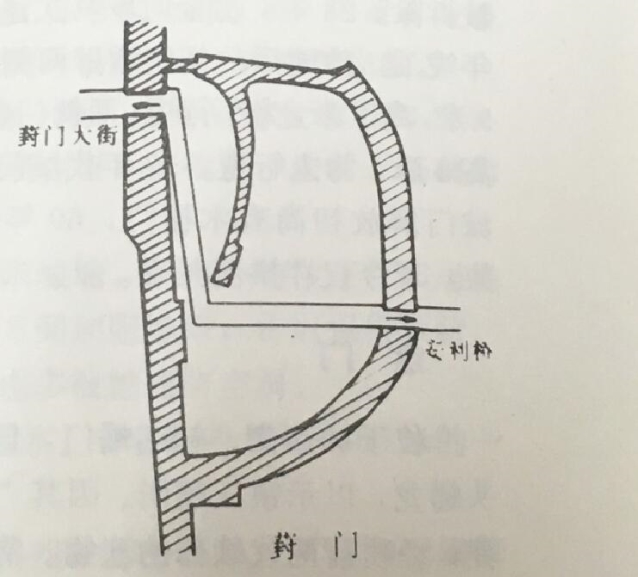
▲ Diagram of Fengmen Gate
A Selection of Poems on Fengmen Gate
Fengmen Gate
Ye Shi
These words written long ago bear my thought;
What I intend to do is emulating the Sage and transcending the self.
To cut the retreat one can advance nowhere;
To make the right strong one leaves the left weak.
Character should be used to determine the size of tax people pay;
Sense of justice distinguishes the courageous from the fainthearted.
The wise statesman Duanmu spoke highly of Duke Wen of the State of Wei,
All on Rivers of Zhu and Si where sages lived can be royal counselors.
Confucius praised Bo Yi and Shu Qi for their noble integrity;
Yet later scholars admire what is eccentric and petty.
They have always treated the most serious matters as lightly,
As if they were of no consequence.
True knowledge lies beyond the reach of words,
Like weaving a net to give the fish a lesson.
Who is it, armed with inner emptiness,
Yet living licentiously and believing nothing is off limits?
Behind this gate is my humble little study;
It has contained a myriad forms of desolation and silence.
What comforts me is that there are still a few like-minded people there;
With our clumsy strength, we endure hunger and care.
How could I ever get hold of those willow catkins (referring to “unprincipled people”)?
They fly to the ends of the earth and become mere spittle in the air.
Only the heavy dew remains, weighing down all the red peonies,
Until they droop throughout the garden bed.
Bound to Suzhou
Fang Hui
On the balcony, she holds the jade wine cup with cheeks aflush,
As if glimpsing sweet apparition of the Goddess of Wu Mountain.
All her life she thinks of Suzhou was the finest land,
Then why is she now rowing a boat away through Fengmen Gate?
Setting off Early from Fengmen Gate with Favorable Winds Speeding Us to Anchor at Zaolin
Qian Weishan
In front of the White Dragon Temple, wind rises and waves swells,
As my boat has just left King Helv’s capital city.
Under the fair, frosty moon, wild geese are heading for their destination a thousand miles away;
At the crow of the rooster in the fifth watch, I dress in hurried disarray.
Rhythm of the oars echoes the fisherman’s song, and the river flows into my dreams;
The sail greets the rustic views, as the trees on the banks mark the miles we’ve passed.
How far and vast the boundless autumn bleakness extends among the reeds!
My sorrow is deepened to the extreme by the tune for marking past the frontier from a Tartar pipe.
For the Filial Woman of Fengmen, at Zhu Cunli’s Request
Cheng Minzheng
All those who constantly bicker and squabble marvel at the woman’s name for filial devotion to her mother-in-law.
She sliced flesh from her thigh to brew the healing broth, and sold her hairpin to secure a burial site through divination.
Just as the filial Cui clan of Qinghe sets an excellent example for the world;
The woman earned the high praise of her community in the Wu commandery.
I stroke the scroll and heave sigh after sigh;
The transforming rule of King of the Zhou State has spread.
For Student Ma at the Eastern Stream beyond Fengmen Gate
Zhu Yunming
With water on its three sides, the city of Wu is a land of waters;
Beyond its southeastern city wall, a single branch of the river flows.
I envy you for dwelling in such a pure and peaceful place;
Moving farther and farther east, one may find the fabled Penglai Isle of Immortals.
Ascending Fengmen Gate Tower with Xing Liwen
Wen Zhengming
A strange wind from the sky sets the wooden weather-vane creaking in the void;
The crenelated battlements stand jagged in the glow of the setting sun.
The hundred-mile landscape remains as grand as it used to be;
From countless homes, the rising smoke promises a year of good harvest.
Lush gardens stretching southward veil all the traces of the past;
If one looks northward, in the wasteland, he can make out the old palace.
I try to grasp the principle behind the rise and fall of a thousand years;
Then I can gaze toward the horizon with you, seeing off wild geese flying away.
Improvised at Fengmen Gate
Qian Zai
By the Miedu Bridge, willows are mirrored in the river over which the bridge gracefully curves;
The southern breeze sweeps the town, laden with an overwhelming fragrance.
In half of the riverside fields, purple-tasseled rice is grown,
Under straw hats faces of peasant women in blue linen show, now and then.
A Selection of Old Photos of Fengmen Gate
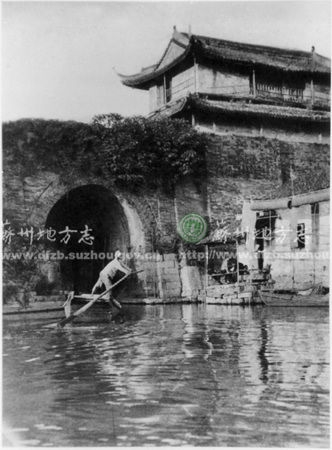
▲The Tower of Fengmen Gate (taken around 1900)
Some refer to it as the Fengmen Water Gate while others call it the Changmen Water Gate.
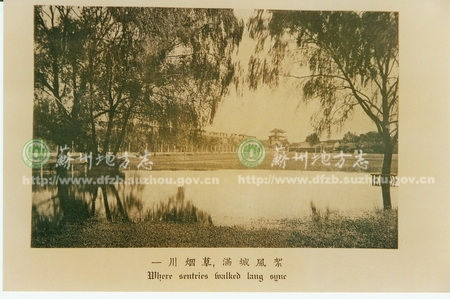
▲ A Distant View of Fengmen Gate
This is a photo taken in 1926 from the sports field of Soochow University, showing the tower of Fengmen Gate in the distance.
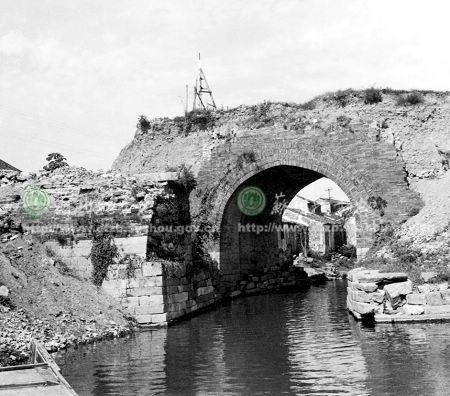
▲ The Fengmen Water Gate (taken in the 1950s)
The photo features the Fengmen Water Gate as a relic after the city wall was demolished in the 1950s. It remained there until the late 1960s.
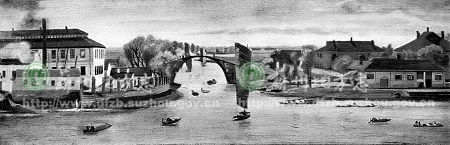
▲The Suzhou Customs
The year 1896 saw the establishment of the Suzhou Customs outside Fengmen Gate. It helped to open the port for international trade. That is the reason why it was commonly referred to as “Yang Guan” (literally “the foreign customs”). Since its establishment to April 1929, the role of Customs Commissioner had been held by foreigners. The picture depicts the scene around the Foreign Customs near the Midu Bridge outside Fengmen Gate during those days. To the right of the bridge is the office building of the Customs. The original version is an oil painting.
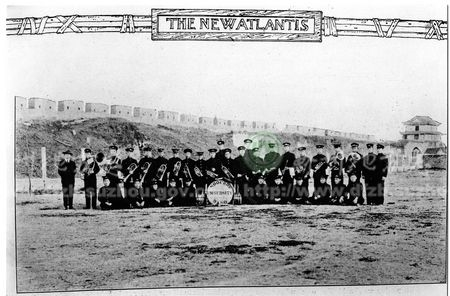
▲The Western Brass Band of Soochow University (1922)
The students, dressed in uniform, are performing brass music. In the background, the city wall of Fengmen Gate and the gate tower can be seen.
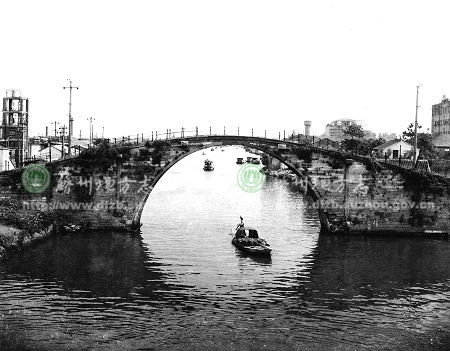
▲Midu Bridge outside Fengmen Gate
The Midu Bridge was originally named the Miedu Bridge (literally “Ferry-Eliminating Bridge”). Its site used to be on the essential route from the Chimen River in the southeast of the city to the Fengmen Gate. Ferry boats were the only means of transport available. However, those boatmen often took advantage of travelers. It is said that a monk named Jingxiu from Kunshan, who had fallen victim to such vicious practices on several occasions, initiated fundraising to build a bridge. Upon its completion, the bridge was named “Miedu Bridge,” meaning “put an end to the bullying of ferry boatmen.”
The bridge was first constructed in the 2nd of Emperor Dade’s reign (1298) during the Yuan Dynasty. Later it was rebuilt by Kuang Zhong in the Ming Dynasty, and repaired during Emperor Tongzhi’s reign of the Qing Dynasty. In 2003, as part of the preservation program aiming to protect the view of the old city, the area was developed into the Midu Bridge Scenic Spot.
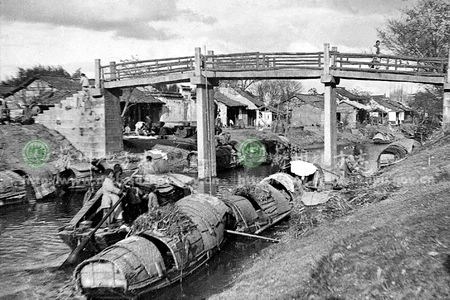
▲ Fengmen River (taken in the 1930s)
The Fengmen River is a river flowing outside Fengmen Gate.
▲ Shipaotou Fort (literally “Stone Fort”)
Located at the strategic intersection of land and water routes at Fengmen Gate, Shipaotou served as a key military stronghold in ancient times. A fort was built right here when Zhu Yuanzhang sent troops to besiege Zhang Shicheng. Stones and iron pellets were then used as artillery ammunition, and hence the name Shi Pao (meaning “stone cannon”). Zhi Jie (literally “a straight street”) in front of the watchtower later came to be known by this name.
Another account holds that watchtowers were built at Tielingguan, Mudu, and Fengmen Gate as defensive measures against the Wokou in the 38th year of Emperor Jiajing’s reign of the Ming Dynasty (1559). According to this theory, Shipaotou was the site where one of those watchtowers once stood.
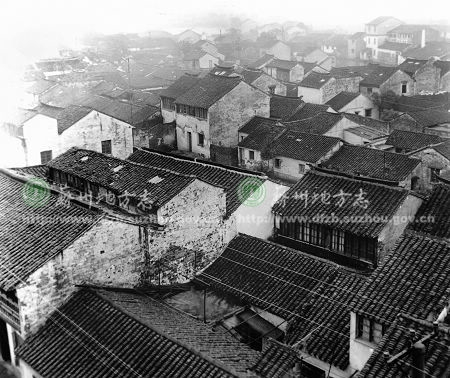
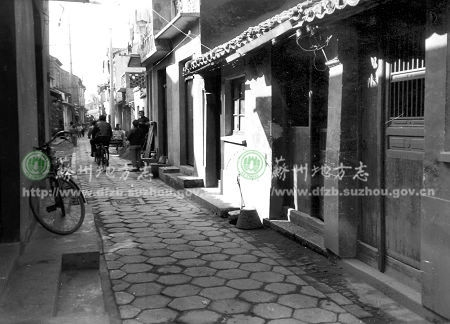
▲ Fengmen Hengjie (taken in the 1980s)
Hengjie Street (meaning “horizontal street”) in the area of Fengmen Gate is located on the north bank of the Fengmen River. The photo offers a bird’s-eye view of the street, showcasing its antique simplicity. The street is a naturally formed commercial hub just outside the city.
A Selection of Photos of Present-Day Fengmen Gate
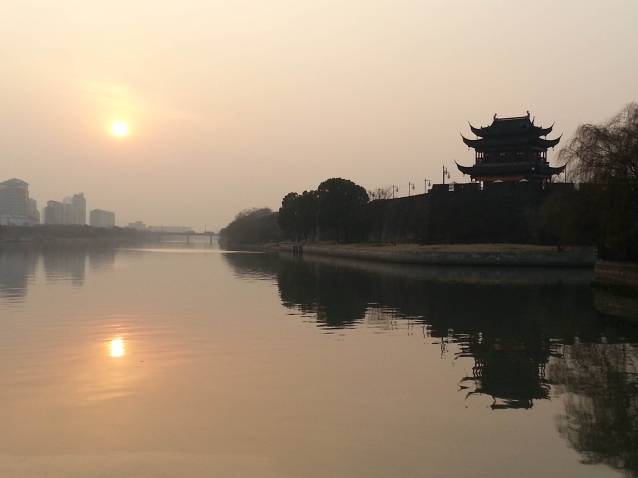
▲The New Fengmen Gate
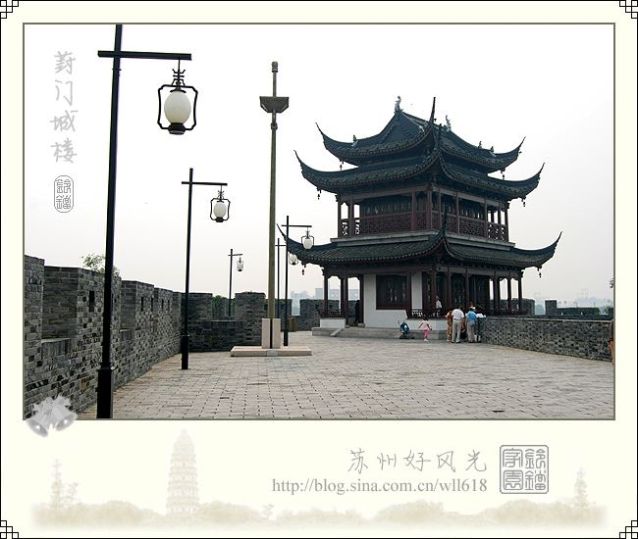
▲ The Tower of Fengmen Gate
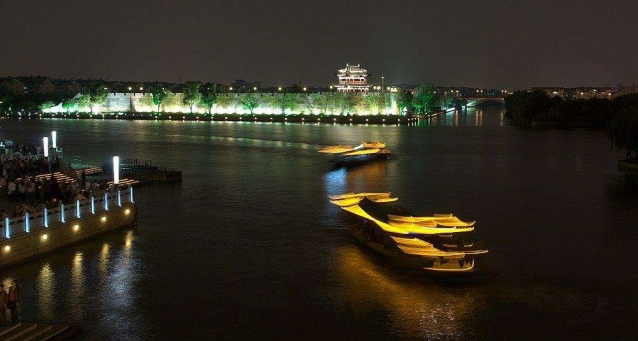
▲ Fengmen Gate by Night
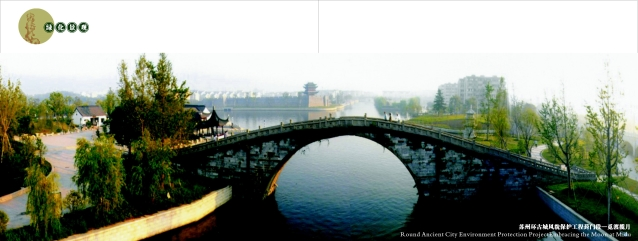
▲ The New Fengmen Gate and Midu Bridge
An Introduction to the Midu Bridge
The Midu Bridge
Originally named Miedu (literally “eliminating ferries”), the Midu Bridge was first constructed in the second year of Emperor Dade’s reign of the Yuan Dynasty (1298). Legend has it that the bridge was funded by the donations raised by Jingxiu, a monk from Kunshan.
According to The Suzhou Encyclopedia (1997), the waterway widened at this spot, which made crossing impossible without a ferry. However, those boatmen often bullied passengers, and even seized their valuables. Jingxiu himself nearly fell victim to such misconduct. In response, he petitioned the local authorities, who subsequently punished the boatmen. At the same time, the monk initiated fundraising efforts to build a bridge.
Upon its completion in 1300, the bridge was named “Miedu,” denoting “eliminating the ferries.” The name also reflects Jingxiu’s aspiration to eradicate such bullying and violence. As recorded in Annuals of Wu County, “his intention is to wipe out violence and injustice.” Over time, the bridge gradually came to be known as “Midu Bridge” due to the similar pronunciations of “灭” (miè) and “觅” (mì) in the Suzhou dialect.
During Emperor Zhengtong’s reign of the Ming Dynasty, Kuang Zhong, the prefect of Suzhou, had the bridge renovated. It was repaired again during Emperor Tongzhi’s reign of the Qing Dynasty. In 1985, the stone balustrades on the bridge were restored when it underwent further repairs in 1985. The bridge is a slender single-arch east-west structure with a length of 81.3 meters. The clear span of the bridge is 19.3 meters, whose rise reaches 8.5 meters. Both slopes formerly contained 53 stone steps. The design adopted a larger single span rather than a multiple-spanned one to accommodate the rapid water flow, large vessels, and a constant flow of boats traffic. The spandrel between the arch crown and surface stones was omitted. Moreover, the slope length was maximized. Thus, the bridge’s elevated yet gradual slope ensures stability while lending it an elegant profile. It is regarded as a masterwork among ancient bridges in the area south of the Yangtze River. In 2002, the bridge was listed as a historical and cultural site under the provincial-level protection in Jiangsu.
A sizable riverside garden has been built near the Midu Bridge Ferry Dock on the Ancient Canal Ring, in which there is a varied assortment of traditional structures including pavilions, terraces, towers, and galleries. The garden boasts quite a few sculptures and elegantly written introduction to the scenic spot as well. The nearby tourist ferry terminal offers boat tours along the entire ancient city moat. The Midu Bridge Scenic Area has now become a favored destination for both sightseeing and leisure.
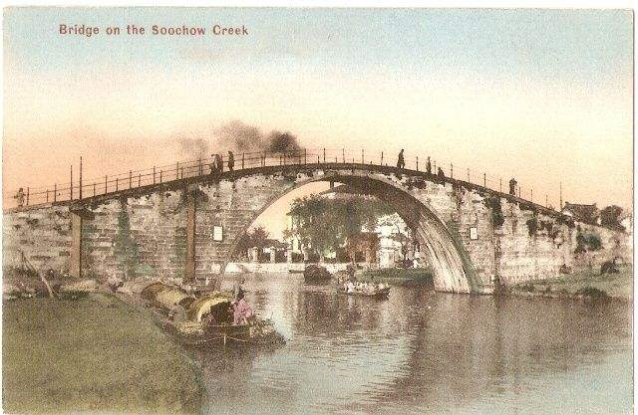
The Midu Bridge, oil on canvas
