Origin and Craftsmanship of Taohuawu Woodcut New Year Paintings
New Year woodcuts are folk artworks known for their unique painting style and decorative values. Traditionally used during festivals as symbols of “out with the old, in with the new,” they carry rich cultural meanings. Taohuawu in Suzhou used to be the centre for producing folk New Year prints in the area south of the Yangtze River. Its prominence owes to its early development as well as to its enduring and well-preserved tradition. As a result, Suzhou’s New Year prints are commonly referred to as “Taohuawu New Year prints,” while the woodcut versions are also called “Gusu prints” or “Suzhou prints.”
Taohuawu woodcut New Year prints have preserved and continued the refined multi-block, multi-color overprinting techniques of the Ming dynasty. The creation of a single print involves three closely linked steps, namely drafting the design, carving the woodblocks, and printing with multiple color blocks. When necessary, additional steps such as hand-tinting and mounting are performed as well. The process is characterized by intricate and labor-intensive procedures.
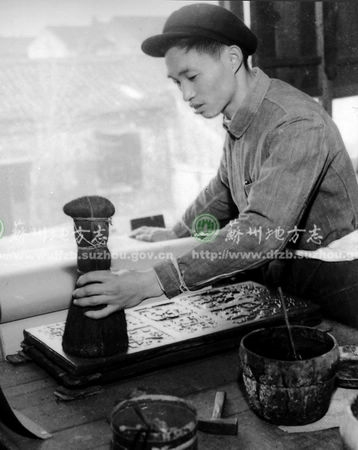
▲ The photo, taken in the 1950s, shows the hand printing technique of Taohuawu woodcut New Year prints.
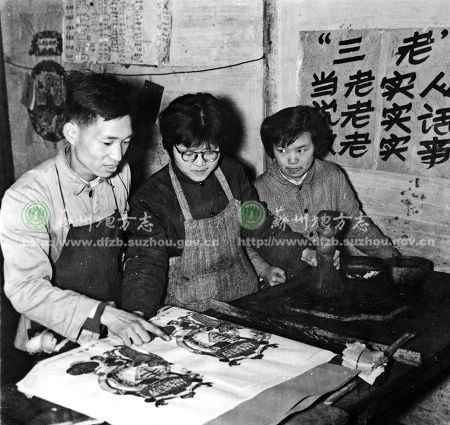
▲ The photo, taken in the 1960s, depicts staff members of the Suzhou Taohuawu Woodcut New Year Print Society at work.
The Development of Taohuawu Woodcut New Year Prints
During Emperor Kangxi’s reign of the Qing dynasty, Taohuawu New Year prints began to flourish. By the reigns of Emperor Yongzheng and Emperor Qianlong, the woodcut craft had reached a greater peak of prosperity. Suzhou became known as one of China’s two centers of New Year folk prints alongside Tianjin whose Yangliuqing prints also enjoyed great popularity. The two schools of folk prints used to be referred to as “Southern Taohuawu, Northern Yangliuqing.” In the Taiping Heavenly Kingdom period, Suzhou’s New Year print studios were damaged by war. The printing blocks from shops in the Fengqiao and Shantang areas were burned down. Before the War of Resistance Against Japanese Aggression, only three Taohuawu print studios were still in business, namely Hongyunge, Wangrongxing, and Wujinzeng. During the Japanese occupation of Suzhou, the printing blocks of Wujinzeng were destroyed by Japanese soldiers, and the studio had to be closed down. Just before the city’s liberation, the centuries-old and renowned Taohuawu New Year print industry had declined to the verge of extinction.
Taohuawu New Year prints gradually revived and developed after the founding of the People’s Republic of China. During the Cultural Revolution, the production of Taohuawu New Year prints were forced to cease. In 1971, following the recommendation of the Working Group on Arts and Crafts of the municipal Bureau of Light Industry and Chemical Industry, a team for the revival of Taohuawu New Year Prints Team was established and affiliated to Suzhou Folk Arts and Crafts Factory. The year 1979 saw the successive restoration of the Taohuawu Woodcut New Year Prints Society and the Taohuawu Woodcut New Year Prints Research Association. From 1980 to 1985, the creation of Taohuawu New Year prints experienced a resurgence, with a batch of works featuring fresh themes and engaging presentation. The Taohuawu New Year Prints Society merged with the Yishizhai Studio in September 1985. For external operations, they maintained both original names, while internally they adopted a unified administrative structure. The society then had a staff of thirty-four. While Taohuawu New Year prints continued to be created and produced in the traditional way, offset printing began to be adopted at the same time. They were distributed by Jiangsu Xinhua Bookstore chain across East China, achieving an annual sales volume of over 300,000 copies.
After the 1980s, changes in people’s lifestyles led to a decline in the diminishment of practical use of Taohuawu woodcut New Year prints. The Suzhou Municipal Government decided to transfer the administration of the Taohuawu Woodcut New Year Prints Society to the Suzhou Art & Design Technology Institute on May 18, 2002. In January 2004, traditional Taohuawu woodcut works, namely “The Sentimental Pipa”, “Kylin Delivering a Son,” “Liu Hai Playing with the Golden Toad,” and “Ten Beauties Playing the Ball” were chosen as subjects of a stamp series designed and publicly released by the State Post Bureau.
On May 20, 2006, Taohuawu New Year prints were approved by the State Council and included in the first batch of the National List of Intangible Cultural Heritage.
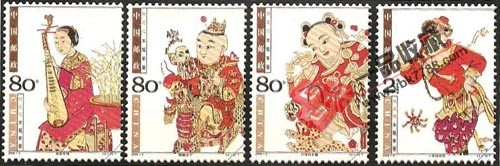
▲ The postage stamps features Taohuawu woodcut New Year prints—“The Sentimental Pipa,” “Kylin Delivering a Son,” “Liu Hai Playing with the Golden Toad,” and “Ten Beauties Playing the Ball,” publicly released in January 2004.
Masterpieces of Taohuawu Woodcut New Year Prints
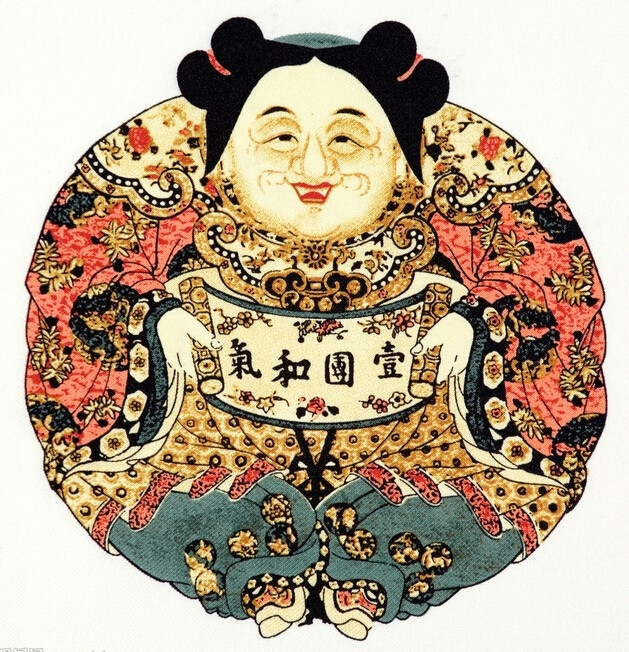
▲ Aura of Harmony
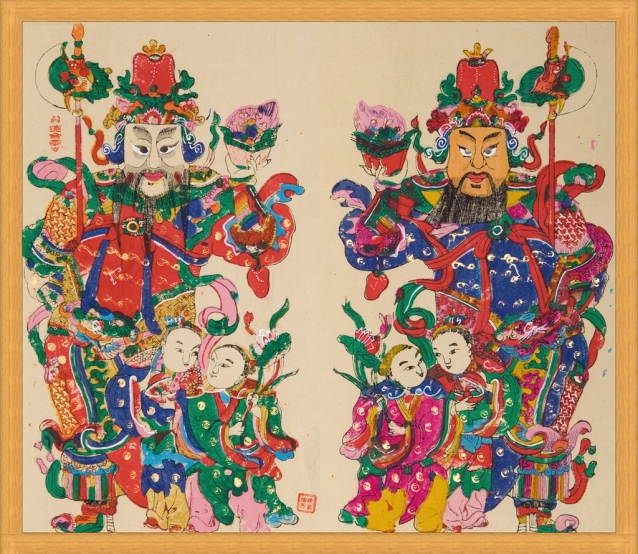
▲ Door Gods
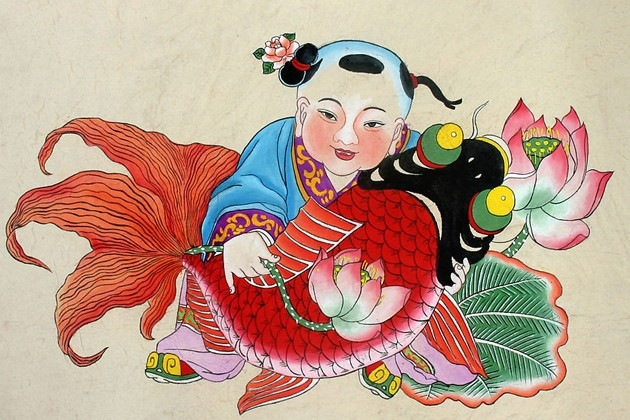
▲ Lotus and Fish Bringing about Abundance and Affluence