The Dragon Boat Festival is called ‘Duanwu’ in Chinese. It occurs on the 5th day of the 5th month of the Chinese lunar calendar, which is the source of the festival's alternative name, the Double Fifth Festival.
Three of the most popular activities conducted during the Duanwu Festival are preparing and eating zongzi, drinking realgar wine, and racing dragon boats. Other common activities include hanging icons of Zhong Kui (a mythic guardian figure), hanging mugwort and calamus, taking long walks, and wearing herb-stuffed sachets. Other traditional activities include a game of making an egg stand upright, knotting with strings of five colors, hanging symbols of five toxic animals, and writing spells. All of these activities, together with the drinking of realgar wine, were regarded by ancestors as effective in preventing disease or evil, while promoting health and wellbeing.
Dragon Boat Race on Jinji Lake
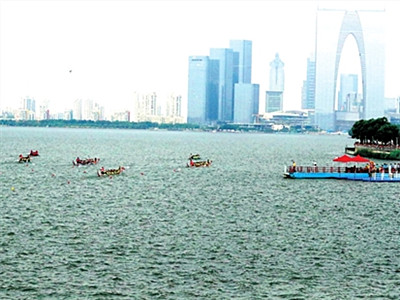
70 teams participated in this years’ Jinji Lake Dragon Boat Race on May 30, the date of the Dragon Boat Festival.
The Jinji Lake Dragon Boat Race was first held in 2010, and was welcomed by citizens and grew rapidly. This year, the race still consisted of two parts: the 300-meter 12 person small dragon boat race and the 300-meter 22 person large dragon boat race. 57 teams participated in the small dragon boat race while 13 teams joined the large dragon boat race, involving 1,320 participants (20% more than that of last year) who came not only from Suzhou, but also from neighboring cities such as Nanjing and Changzhou. There were also 214 overseas participants from 22 countries and regions.
The team from Cafoscari University of Venice participated in the female 300-meter 12 person small dragon boat race. Team leader Zhu Anna, a Chinese Italian, said her team consisted of university students and professors.
While the dragon boats raced on Jinji Lake, Jetlev-Flyers and paramotorists demonstrated their skills above the lake.
“Dragon boat racing is a traditional folk sport, and we plan to set up a ‘Suzhou Dragon Boat Association’ to promote the activity,” said Tao Yongjie, the Deputy Director of Suzhou Sport Bureau.
Zongzi-making competition
Nearly 50 residents from 21 communities in the area of Canglang Street, Gusu District competed against each other on May 29 for the title of the ‘fastest zongzi maker’.
Participants’ ages ranged from 50 to 70 years of age, with most of them experienced in the art of zongzi making. When the referee whistled the start of the event, they wasted no time in grasping reed leaves, shaping them into little funnels, then pouring glutinous rice into the funnel. They then folded the reed leaves into different shapes, and wrapped them with string to make the finished zongzi. Most people made zongzi of three corners, as it is the simplest shape to make; but some others made ‘pillow zongzi’ and ‘small-corner zongzi’, which are more complicated.
The 21 communities all sent their own teams to participate in the group competition. The competition took just five minutes, and the fastest team, which was from Zhuhui Community, made 45 zongzi. There were also 21 individuals to compete for the fastest zongzi maker individual. Each of them made only one zongzi, and the person who finished the quickest won. Most of the participants made a zongzi within 20 seconds, but Qiu Kangmei, aged 66, made a three-corner zongzi in only 9.13 seconds, and won the fastest zongzi maker title. She said she had made zongzi for nearly 20 years. As the oldest among 6 siblings, she used to make about 200 zongzi with 20 kg of glutinous rice for her little brothers and sisters. She can finish the zongzi making work within one day.
37% of people don’t know to whom the festival is dedicated
Canglang Xincheng, Gusu District carried out a survey on who the Dragon Boat Festival celebration in Suzhou is dedicated to, with 57 out of the 200 residents from 29 communities answering incorrectly. 128 people correctly determined that the Festival in Suzhou was a memorial for Wu Zixu (died 484BC, a statesman and general of the Wu Kingdom), rather than for Qu Yuan (340-278BC, a poet and minister of the State of Chu), who was more widely linked with the Dragon Boat Festival. Yet another 15 people could not think of a name connected to the festival.
The survey also found that most people did not know why we eat ‘zongzi’ on the day, as most answered “other people all eat zongzi, so we eat zongzi too,” or “older generations made zongzi to eat on the day when I was little, so I continue the tradition.”
Only 16 people could list over five traditional activities associated with the Dragon Boat Festival, 42 people listed three to five activities, 83 people named two of them and 59 people only knew of one activity. Meanwhile, 80% of respondents answered ‘eating zongzi’ as their best Dragon Boat Festival experience. The survey found that most people only know about zongzi and dragon boat racing when asked about the Dragon Boat Festival celebrations. But as the dragon boat race only involves a very limited number of people, for most of society the festival has transformed into a ‘zongzi day’.